The East Side Gallery, Mural by Mural: What the Paintings Are Actually Saying
It is the longest surviving stretch of the Berlin Wall and the most photographed: 1,316 metres of concrete along the Spree, painted end to end in the spring of 1990 by 118 artists from 21 countries. Almost everyone who comes takes the same picture of the same kiss and leaves. Which is a pity, because the wall is saying something quite specific and almost none of it is written down on site — the panels carry no captions. This guide walks the gallery mural by mural: what each painting is about, who was standing where when they made it, and what the concrete under the paint actually was.
The Wall in Berlin
The East Side Gallery mural by mural, plus a free audio walk from Ostbahnhof to the Oberbaumbrücke.
Topics
What you are actually looking at
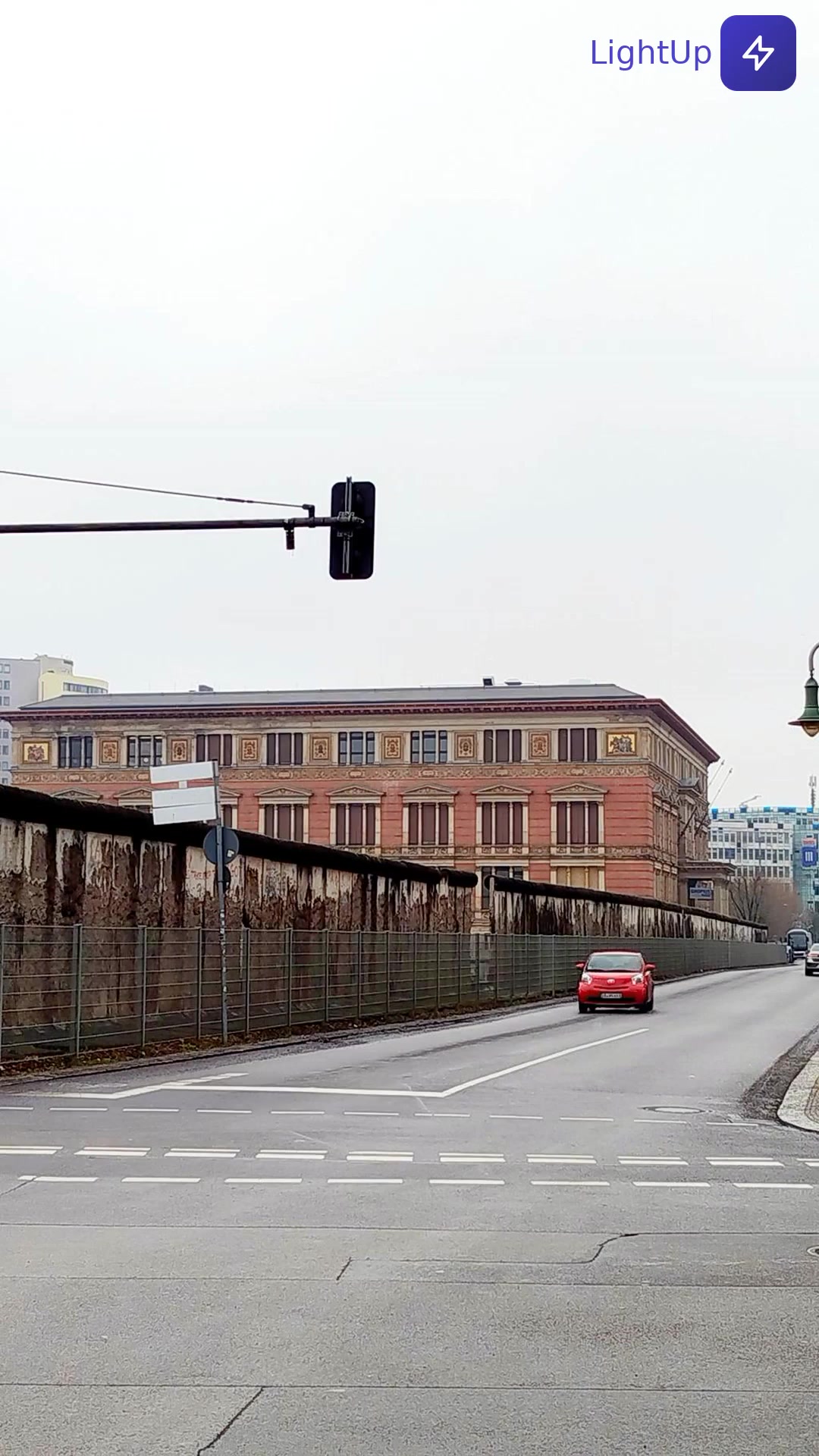
The East Side Gallery runs for 1,316 metres along Mühlenstraße, between Ostbahnhof and the Oberbaumbrücke. It is the longest piece of the Berlin Wall still standing where it was built, and it is a listed monument — protected since November 1991, barely a year after it was painted.
One thing is worth knowing before you walk it, because nothing on site tells you. This concrete is not the wall the world saw on television. It is the inner wall, the one that faced East Berlin, and for twenty-eight years the side you are now standing on was the death strip. The border itself ran out in the river: this stretch of the Spree belonged to East Berlin, bank to bank, which is why people drowned trying to cross water that looked like freedom.
So the paintings are on the side almost nobody was allowed to see. They were made in the spring and summer of 1990, in the months between the opening of the border and reunification, by 118 artists from 21 countries who came to Berlin because the wall was suddenly a surface anyone could reach. The gallery opened on 28 September 1990.
Audio guides on this stretch
The kiss everybody photographs
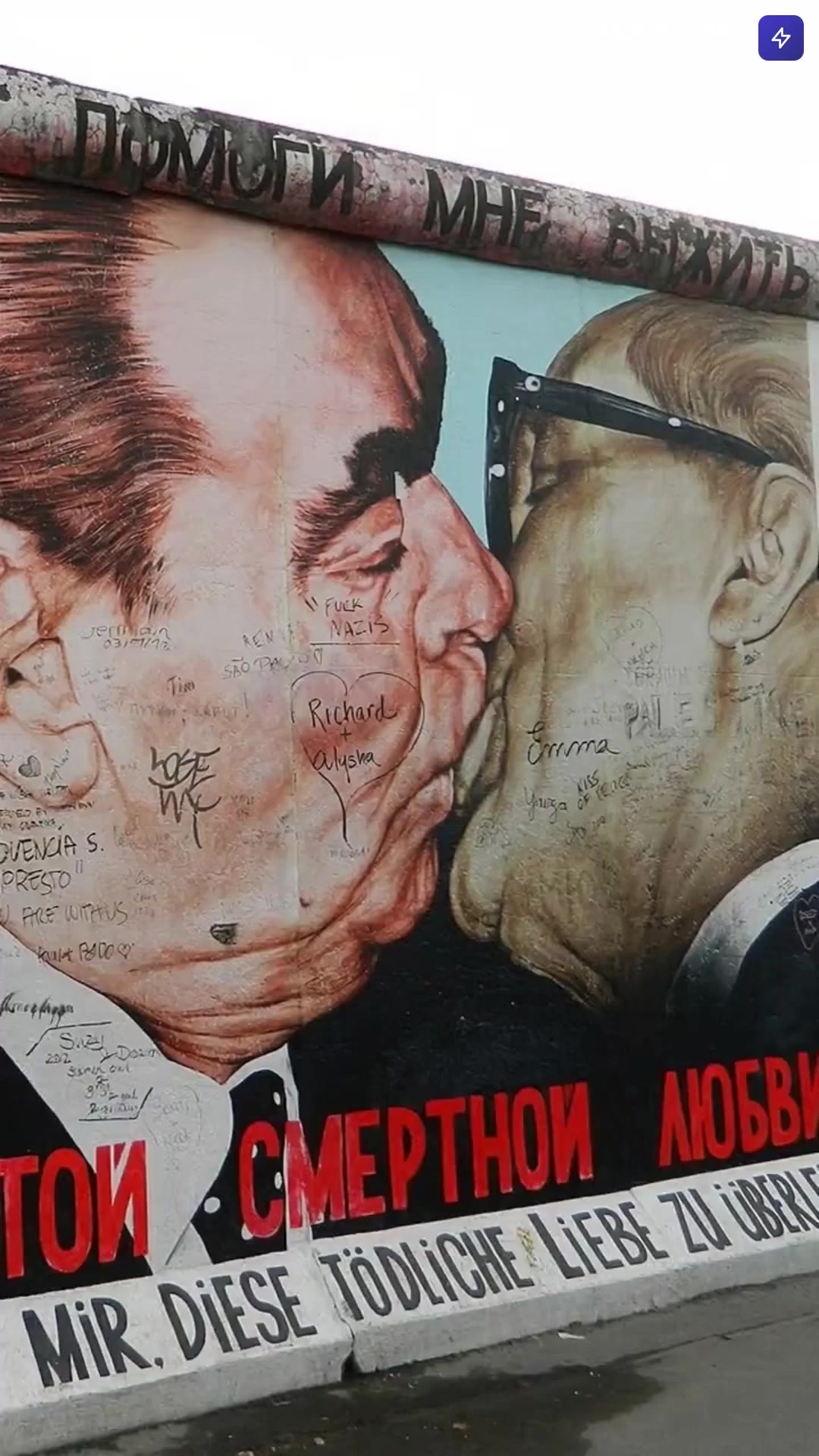
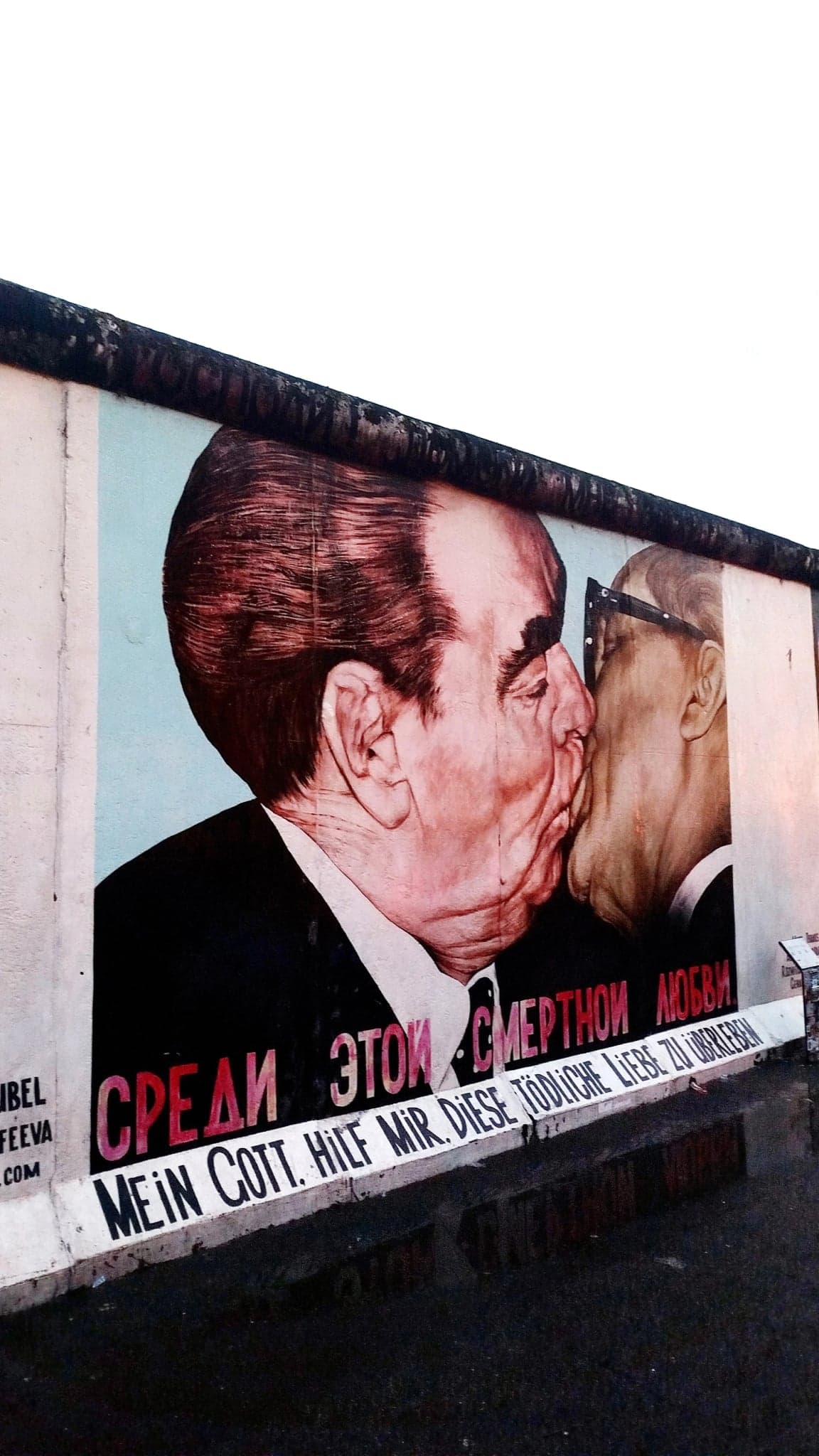
Two men in dark suits, mouths together, seven metres wide. They are Leonid Brezhnev, leader of the Soviet Union, and Erich Honecker, head of East Germany, and the painting is Dmitri Vrubel's 'My God, Help Me to Survive This Deadly Love'.
It is not invented. Vrubel worked from a photograph taken by the French photojournalist Régis Bossu on 7 October 1979, at the celebrations for the thirtieth anniversary of the GDR. What it shows is the socialist fraternal kiss, a piece of political protocol between allied leaders — mouth to mouth, in public, on purpose. Bossu's picture went around the world precisely because the protocol looked, to Western eyes, like something else entirely.
The title runs along the bottom in Russian and German. It reads as a prayer, and it is aimed at the alliance, not at the two men: a plea to survive a love that was killing the country it embraced. Vrubel painted it in 1990 and repainted it himself in 2009. It is the most reproduced image of the entire wall, and standing in front of it you can see the brushwork that the postcards flatten out.
Audio guides on this stretch

The Trabant coming through the wall
A Trabant — the small, slow, two-stroke car that East Germany built for thirty years and that families waited a decade to receive — bursts head-on through the concrete, cracks radiating from the bonnet. The painting is by Birgit Kinder.
Look at the number plate: NOV 9–89. The ninth of November 1989, the night the border opened. Trabants really did come through that night in their thousands, nose to tail down Bornholmer Straße and every other crossing, honked at and handed flowers by West Berliners who had never seen so many at once.
The car is the joke and the point at the same time. Nothing about a Trabant was powerful. It was made of cotton-reinforced resin and could barely overtake. What broke the wall was not force; it was an enormous number of very ordinary people driving very ordinary cars towards a border guard who had run out of orders.
Audio guides on this stretch

The faces of November
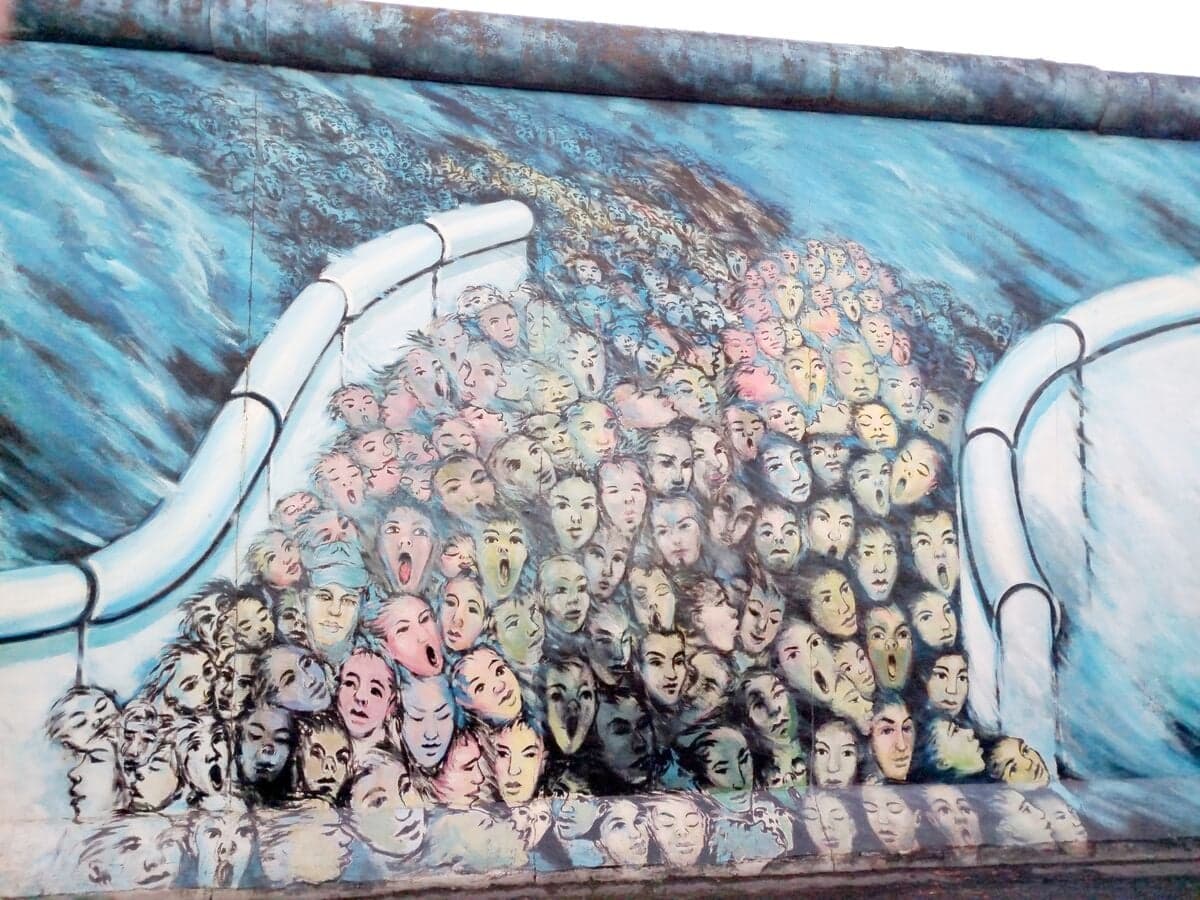
A flood of heads pours through a gap in the wall towards you, dozens of them, painted in pale flesh tones. It is 'Es geschah im November' — 'It happened in November' — by Kani Alavi, an Iranian-born painter who has lived in Berlin since the 1980s.
Alavi watched it happen. On the night of 9 November 1989 he was at his window near Checkpoint Charlie, above the street, as the crowd came through beneath him. The mural is that view: the crowd seen head-on, squeezing through an opening that is too small for it.
Look at the faces one at a time and the mural stops being a celebration. Some are euphoric. Some are frightened. Some are simply blank, the expression of people who do not yet know what has happened to their lives. Alavi has said he wanted the whole range, not the version that was already being edited for television.
Audio guides on this stretch

The ones nobody stops at
Between the three famous panels there are more than a hundred others, and the crowds thin out within metres of the kiss. 'Danke, Andrej Sacharow' thanks Andrei Sakharov, the Soviet physicist who helped build his country's hydrogen bomb and then spent the rest of his life campaigning against it, won the Nobel Peace Prize in 1975, was exiled inside his own country for it, and died in December 1989 — five weeks after the wall opened.
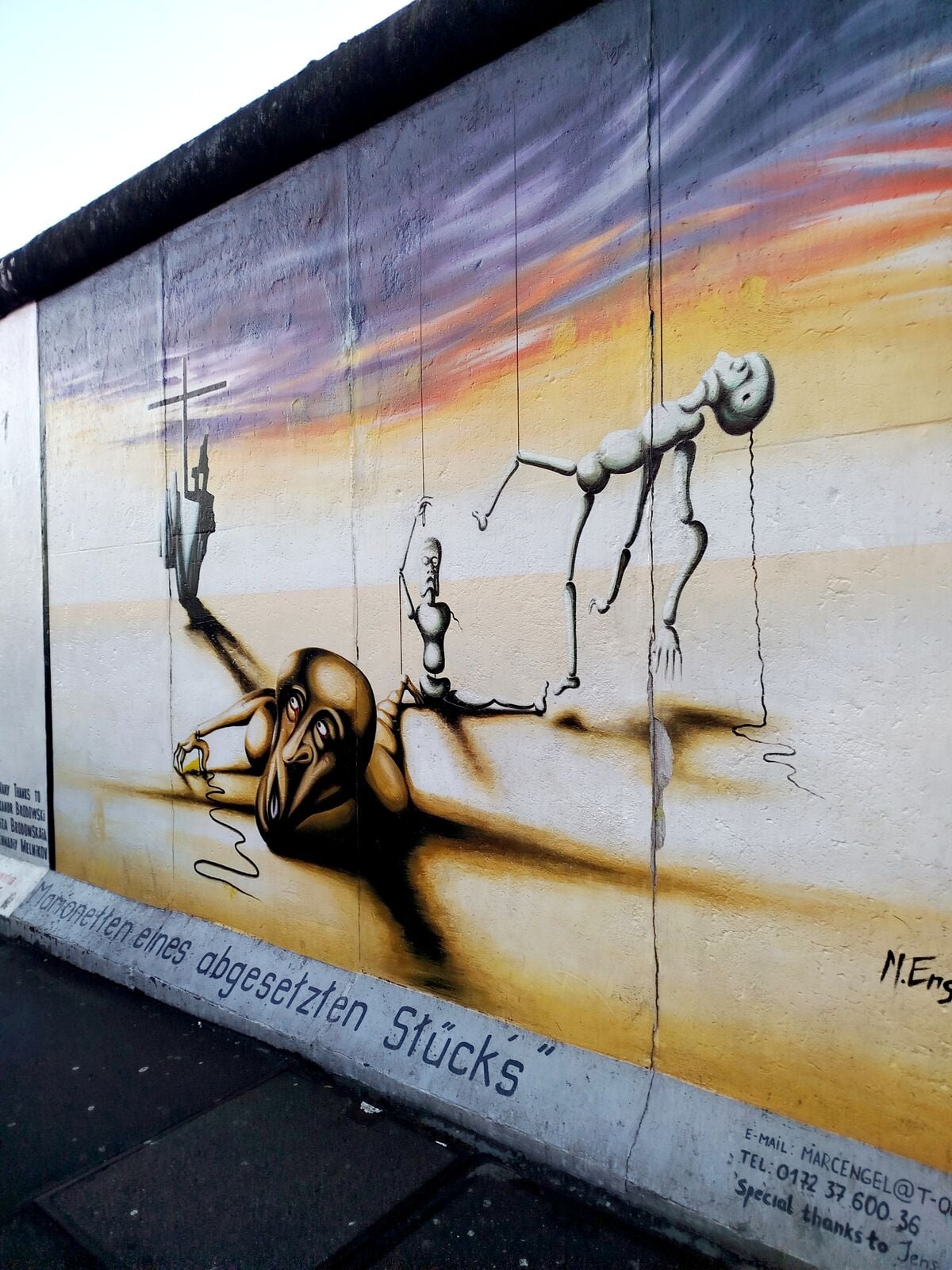
'Marionetten eines abgesetzten Stücks' — puppets from a play that has been taken off — shows figures hanging from strings with nobody left holding them. Painted in 1990, it is about what happens to the people who performed a system after the system stops being performed.
Further along, figures in white protective suits and gas masks stand in a row. That one is about Chernobyl, four years old at the time of painting and still unspeakable in the East. These are the panels worth slowing down for: nobody is queueing, and they are where the gallery stops being a backdrop and starts being an argument.


What happened to the paintings
Outdoor paint on unprimed concrete does not last. By the early 2000s the gallery was cracked, faded and covered in tags, and in 2009 the wall was stripped and the artists were invited back to repaint their own works from scratch. Most did. Some refused, on the grounds that a repainted 1990 painting is a copy of a 1990 painting, and that the damage was part of the record.
The wall has also been moved and cut. Sections were removed to build access to the river, and in 2013 the removal of a stretch to make way for a riverside development brought thousands of people out to stand in front of the machines. Some of it went anyway.
So what you walk past is not a frozen artefact from 1990. It is a monument that has been repainted, defended, argued over and sprayed on continuously for thirty-five years — which, for a wall, is a more honest afterlife than being preserved untouched behind glass.
Walking it mural by mural
If you are going to Berlin, this is the walk to do here. Start at Ostbahnhof and head east with the river on your left; you finish at the Oberbaumbrücke, the double-decker brick bridge that was itself a crossing between East and West. Straight, flat, 1.3 kilometres. An hour if you stop, twenty minutes if you don't.
The catch is that the panels have no labels. Nothing tells you which painting is which, who made it or why it is there, so a hundred murals turn into wallpaper within five minutes — which is exactly why most visitors photograph the kiss and leave.
So we made the walk as a free audio guide, mural by mural. It shows you where to go and starts each story the moment you arrive at that painting, in your language, in order. No tickets, no meeting point, no group to keep up with: you set the pace, and you keep your eyes on the wall instead of on a screen.
Walk this route
The East Side Gallery, Mural by Mural
6 stops · 46 min · Berlin
The longest stretch of the Berlin Wall still standing, painted by artists from twenty-one countries in the spring after it fell. Six stops along the river, from the Oberbaum Bridge to the murals that made the wall famous.
🇬🇧
Scan it with your phone to open this tour in the app
Open the tourHow to visit
It is open air, free, and never closes. The nearest stations are Ostbahnhof at one end and Warschauer Straße at the other, and there is no ticket, no queue and no opening time to plan around.
Go early or late. In the middle of the day the famous panels are three deep in people taking the same photograph, and the light comes straight off the river into your lens. Early morning is empty and the paint is at its best.
One thing worth saying: people do still write on the murals, and the artists' initiative has spent years cleaning it off. The wall already carries the marks of everyone who has passed. Adding yours is not adding anything to it.
Audio guides in Berlin
Hear Berlin narrated in 7 languages
More from the blog


Take LightUp with you
Self-guided audio tours in 7 languages, offline-ready. Download the app and start exploring.