
Bakery House · Audio guide
Listen to the story of Bakery House
Download the LightUp app or scan the QR with your phone. You'll hear this place narrated in your language — 7 languages available, AI and human voices. Free to start, walk Madrid at your own pace.
Scan with your phone
Point your camera at the QR code
Story
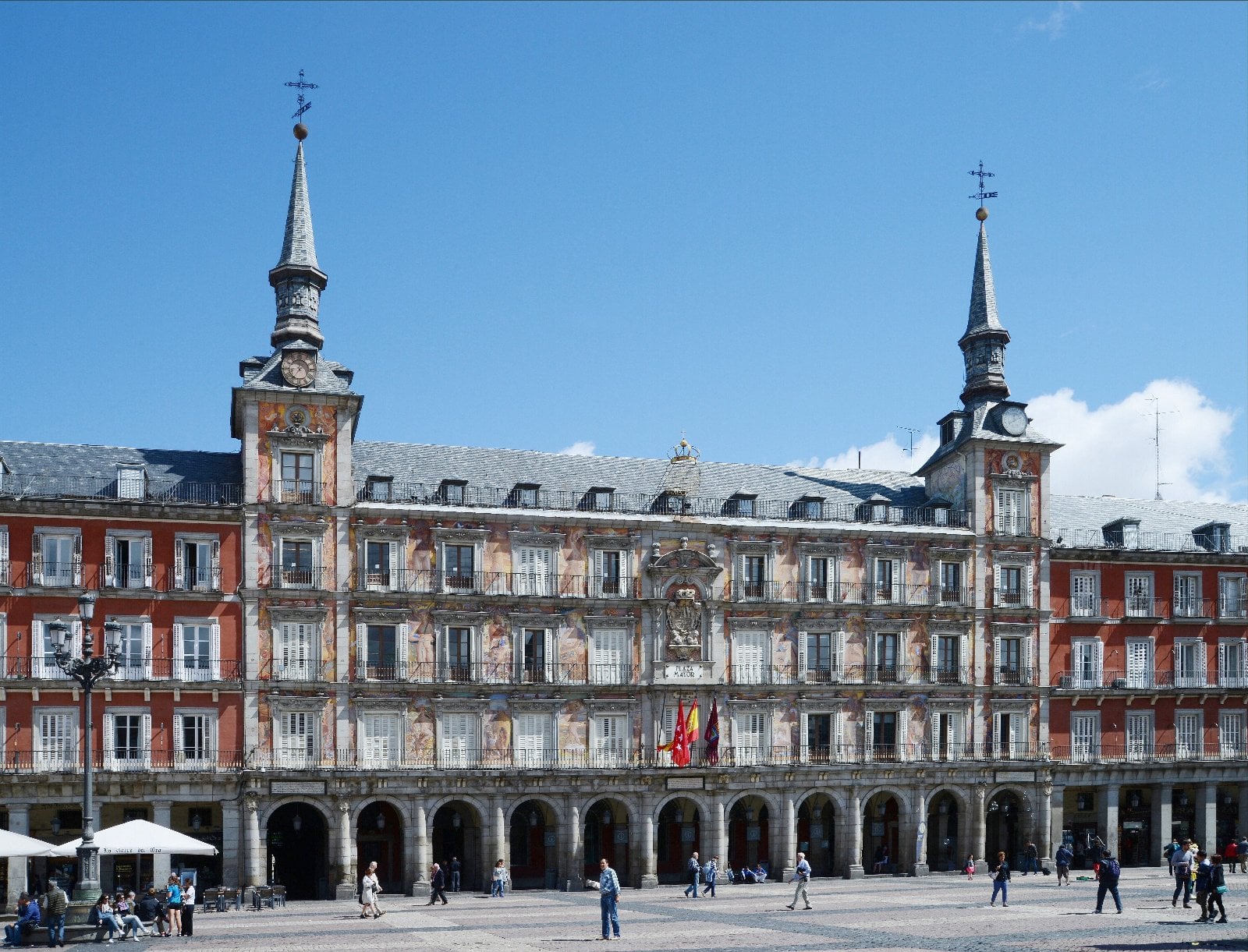
In Plaza Mayor stands out a unique building: two slate towers, mythological frescoes on the facade, the only one without red walls. Let me tell you what happened here.
Fifteen hundred ninety. Philip the Second orders an official bakery for the new square: to control the price of wheat, supply the court, avoid hunger.
Diego Sillero builds it here. Bakery below, royal quarters above. Madrid's bread was dispatched from these walls.
Sixteen seventy-two. An August fire devours the building. Tomás Román rebuilds it in seventeen months.
Claudio Coello and Donoso paint baroque frescoes in the royal hall.
Then in seventeen ninety came the third fire. Three-quarters of the square burned. The Bakery House survived intact.
Juan de Villanueva arrives to rebuild — and uses this building as a model. Its height, its proportion, its arcades dictate the new square. What was once a bakery becomes the measure of Madrid.
In nineteen eighty-two a strong storm destroys the original seventeenth-century baroque frescoes. Forty years later, in nineteen eighty-eight, Carlos Franco repaints them from scratch: Cibeles, Bacchus, Cupid, tritons.
They are not a restoration — it's a new canvas on the same wall. Three and a half meters high, six months of brushstrokes.
Inside: baroque vaults on sixteenth-century foundations, the central balcony where kings watched bullfights, the coat of arms of Charles the Second carved in Genoa.
Today civil weddings and tourism occupy the rooms. Listen to the complete guide and I'll tell you about it.
Visiting Bakery House
- How to get there
- The closest bus stop is Plaza Mayor, 40 meters away.
Frequently asked questions
What was the original purpose of the Bakery House?
The Bakery House originally served as the main bakery of Madrid, supplying bread to the royal family and the city's elite.
Who was responsible for the reconstruction after the 1672 fire?
Tomás Román was the architect who reconstructed the Bakery House after the 1672 fire, completing the work in just seventeen months.
What can be seen on the facade of the Bakery House today?
The facade of the Bakery House is adorned with frescoes painted by Carlos Franco in 1992, featuring mythological figures like Cibeles, Baco, Cupido, and Proserpina.
What is the current use of the Bakery House?
Today, the Bakery House hosts the Centro de Turismo de Plaza Mayor and offices of Madrid Destino, and it serves as a venue for civil weddings and city receptions.
What architectural features are notable at the Bakery House?
Notable features include the slate towers, stone arches at the base, and a central coat of arms, all part of the Baroque building that stands today.
More audio guides in Madrid


Comments
No comments yet.