I’ll tell you the secrets of Central Cemetery of Bogotá. I guide you here with the map, or you can listen from home. What you see is not what you think, and knowing it is worth it. Some narrations are AI voices and others are real people.
Go there the app walks you there from wherever you are.
Listen there or from home it plays by itself when you arrive, or press play from wherever you are. In your language if it was recorded in it.
Keep discovering the Bogota map has more gems like this one, and you can put them together in a tour.
What you'll discover
Presidents, poets and revolutionaries buried just metres apart. Planned in 1791, it is the most honest archive of Colombian history.
About Central Cemetery of Bogotá
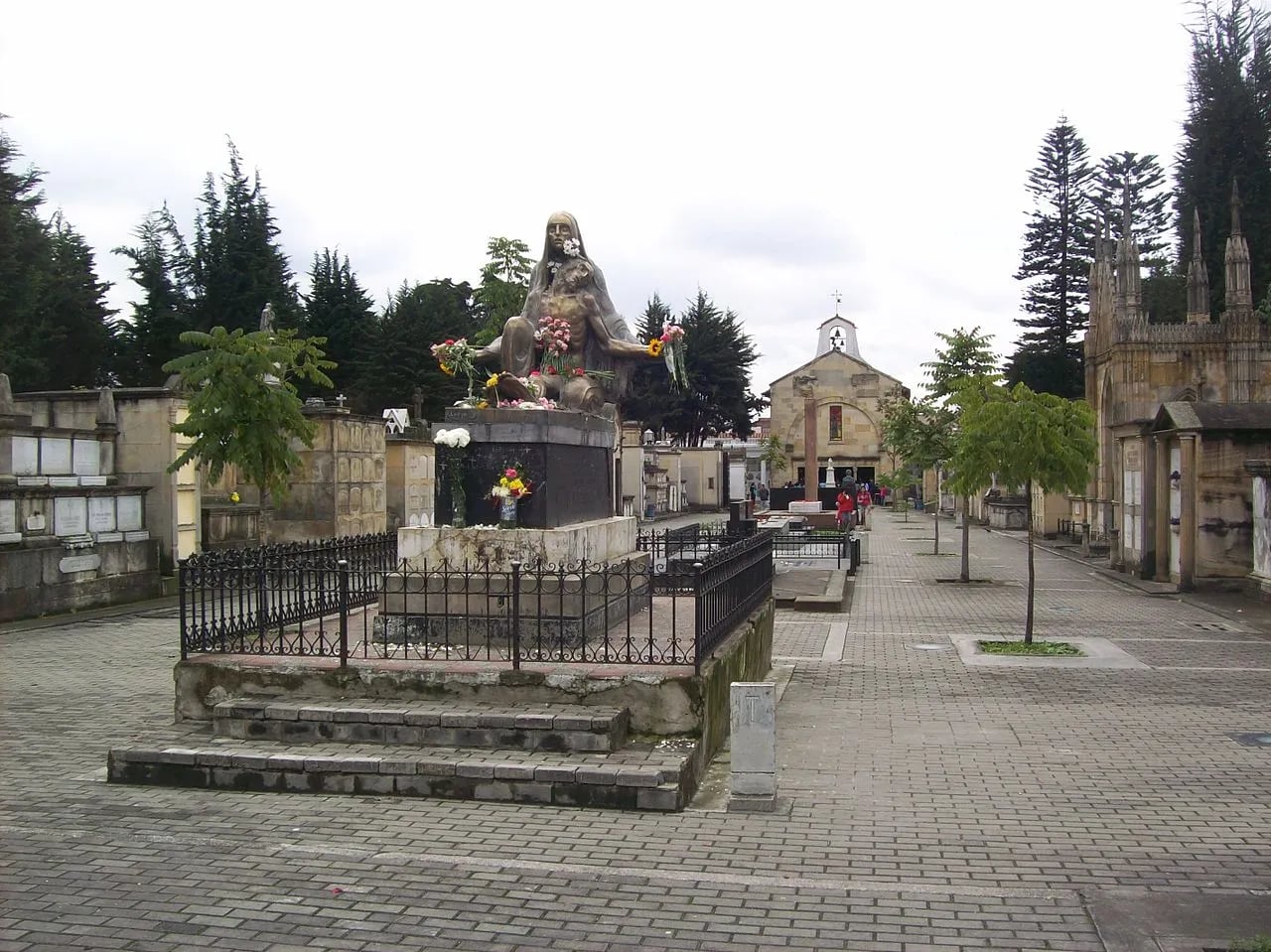
Find a bench, or sit on the steps at the entrance. What you have in front of you is the most honest archive in the history of Colombia, and it deserves a quiet moment before you walk through it. There is no official speech, no curated narrative: only the graves of the people who built, governed, wrote, revolutionized, and sometimes destroyed this country, all on the same ground, separated by just a few meters and the accidents of time. The Central Cemetery was planned in seventeen ninety-one by order of the Viceroy of New Granada, José Manuel de Ezpeleta, as part of the Enlightenment reforms that promoted moving burials out of churches and into open spaces outside the city.
Read the whole storyShow less
It was a European, hygienic, and modern idea: the dead outside the center, the living not having to coexist with them beneath the cathedral floors. Construction began in eighteen thirty-two and the cemetery was inaugurated in December of eighteen thirty-six, under the presidency of General Francisco de Paula Santander. The design was the work of the Spanish military engineer Domingo Esquiaqui, the same man who had come to Bogotá to help rebuild the city after the earthquake of seventeen eighty-five. It is said that the main gate you see was built in nineteen oh-five, almost seventy years after the inauguration. In the central arch is Cronos, the Greek god of time, with his scythe. Below, in Latin, the inscription: exspectamus resurrectionem mortuorum.
We await the resurrection of the dead. It's a phrase that has been there for more than one hundred years, welcoming you every time you enter. It is said that almost thirty former presidents of Colombia are buried inside. Santander was the first to be interred here with state honors, and that set the precedent: the Central Cemetery became the natural resting place for the country's great figures. There are mausoleums of nineteenth- and twentieth-century presidents, generals from the civil wars, politicians of all stripes who once faced off in life and now share the same ground, unable to keep arguing.
But the burials that weigh the most are not those of the presidents who died of old age. They are those of the murdered. Luis Carlos Galán was the Liberal Party presidential candidate with the best chance of winning the nineteen ninety elections. The Medellín cartel identified him as the biggest obstacle to their operations because Galán had promised to reinstate the extradition treaty with the United States that the Supreme Court had annulled in nineteen eighty-seven. On the eighteenth of August, nineteen eighty-nine, during a political event in Soacha on the outskirts of Bogotá, he was shot dead in front of thousands of people. He was forty-five years old. His grave is here.
Carlos Pizarro León-Gómez was the presidential candidate of the M-nineteen, the guerrilla movement that had demobilized in nineteen ninety after signing peace with the government of Virgilio Barco. He was the most visible symbol that it was possible to move from armed struggle to politics. On the twenty-sixth of April, nineteen ninety, just a few weeks after his official candidacy, he was assassinated on an Avianca commercial flight between Bogotá and Barranquilla. A hitman boarded the plane, approached his seat, and shot him. He was thirty-eight years old. His grave is also here. Jaime Pardo Leal was a magistrate of the Superior Court of Bogotá and presidential candidate of the Patriotic Union, the political movement created as part of the peace agreements with the FARC. He was assassinated in nineteen eighty-seven by paramilitaries.
He was one more in a series of Patriotic Union leaders who were systematically exterminated from the mid-eighties onward: more than three thousand militants and leaders murdered in what the Inter-American Court of Human Rights recognized decades later as a case of extermination. Also here are Rafael Pombo, the poet who wrote the children's verses memorized by generations of Colombians, and José Asunción Silva, the modernist poet who published little in his lifetime and took his own life at thirty in eighteen ninety-six. And Leo Kopp, the German businessman who founded the Bavaria Brewery in eighteen eighty-nine, the company that for more than a century dominated Colombia's beer industry.
The cemetery also has a dimension of popular religiosity that was not in the original design. There are three graves that people from Bogotá have turned into informal shrines: people without official canonization but to whom visitors bring flowers, candles, and petitions, and whose tombstones are covered with ex-votos and written messages. It's a practice repeated in many Latin American cemeteries: the city decides on its own who deserves to be intercessors. It was declared a National Monument in nineteen eighty-four.
Frequently asked questions
Who is buried in Bogotá's Central Cemetery?
Reportedly almost thirty former presidents, plus poets, murdered leaders and the founder of Bavaria brewery. The stories of who lies next to whom, LightUp tells you as you walk among the tombs.
What is the history of the Central Cemetery?
Planned in 1791 to move burials out of churches, it opened in 1836. Today it's the most honest archive of Colombian history, and the audio guide shows you why.
Is the Central Cemetery free to visit?
Yes, entry is free. LightUp guides you to the gate and tells you what the words on it mean.
Is there an audio guide for Bogotá's Central Cemetery?
Yes. With LightUp you listen as you walk round or from home, in 7 languages, including the graves locals turned into shrines.