Bolívar Square
 Por Pedro Szekely from Los Angeles, USA - Plaza de Bolivar, Bogota, Colombia, CC BY-SA 2.0
Scan it with your phone
Point your camera at the QR code
Bolívar Square: Palace of Justice, Capitol and CathedralAudio guide
 Told byBogotours
I’ll tell you the secrets of Bolívar Square. I guide you here with the map, or you can listen from home. What you see is not what you think, and knowing it is worth it. Some narrations are AI voices and others are real people.
€0.997 min AI voiceHistory
Audio in:EnglishSpanishGermanFrenchItalianPortugueseChinese
How it works
- Go there
the app walks you there from wherever you are. - Listen there or from home
it plays by itself when you arrive, or press play from wherever you are. In your language if it was recorded in it. - Keep discovering
the Bogota map has more gems like this one, and you can put them together in a tour.
What you'll discover
The symbolic centre of Colombia, where it all began in 1538. Each of the four buildings around it holds a story worth more than many museums.
About Bolívar Square
Find somewhere to sit. It could be on any edge of the square, on any step, in front of any of these buildings. It doesn’t matter. What matters is that you’re standing at the very center of Colombia. Not the geographic center. The symbolic center. The place where it all began. You’re in Plaza de Bolívar. thirteen thousand nine hundred and three square meters of history open to the sky. And when I say history, I don’t mean it in the abstract. Each of the four buildings surrounding you has a story worth more than many museums. And the ground you’re standing on has witnessed things you shouldn’t see. Let’s start from the beginning. It was fifteen thirty-eight. Gonzalo Jiménez de Quesada had just founded the city. He came from the Caribbean Sea, climbed the mountains, found the Muisca people on this high plain, and decided he would stay here.
Read the whole storyShow less
A small straw chapel, twelve huts around it, and this square in the center. They called it Plaza Mayor. Like all Spanish colonial squares: a central space where everything happened. The market, the trials, the viceroyalty’s announcements, public punishments. And yes, the punishments. Because in the center of this square, where Bolívar’s statue stands today, there was a pillory. A stone post where those the colonial authorities considered criminals or traitors were tied up, put on display, and humiliated. Colonial justice was public and brutal. There weren’t prisons full of invisible people. Here, it was in front of everyone. The pillory stood for decades. In fifteen eighty-three, they replaced it with a public water fountain.
More civilized, I suppose. Centuries passed. The square grew, the buildings changed. And then independence arrived. On the twentieth of July, eighteen ten, right here in this square, the Cry of Independence began. Almost three hundred years of Spanish colonial rule, and this was the breaking point. An argument over a vase, a riot, a Government Junta established that very day. It wasn’t a war that came from outside. It was a city that said: no more. Seven years later, in November of eighteen seventeen, in this same square, Policarpa Salavarrieta was executed by firing squad. She was just over twenty years old. She was a seamstress, a spy for the patriots, a messenger between the independence forces. The Spanish captured her, tried her, and on the fourteenth of November brought her here, in front of all Bogotá, to execute her. They say that when they read her sentence, she shouted that they were cowards.
That her blood would be avenged. They killed her, but her name remained. La Pola is now one of the strongest symbols of Colombian independence. In eighteen nineteen, Simón Bolívar entered Bogotá in triumph after the Battle of Boyacá. That battle that sealed independence. The square, which had been Plaza Mayor and then Plaza de la Constitución, was renamed Plaza de Bolívar in eighteen forty-six. And that same year they installed his statue, the one you see in the center. It was sculpted by Pietro Tenerani, an Italian sculptor. It was the first public monument in the entire city. Now look at the four buildings. To the south, the National Capitol. Home of the Colombian Congress. They started building it in eighteen forty-eight and didn’t finish until nineteen twenty-six.
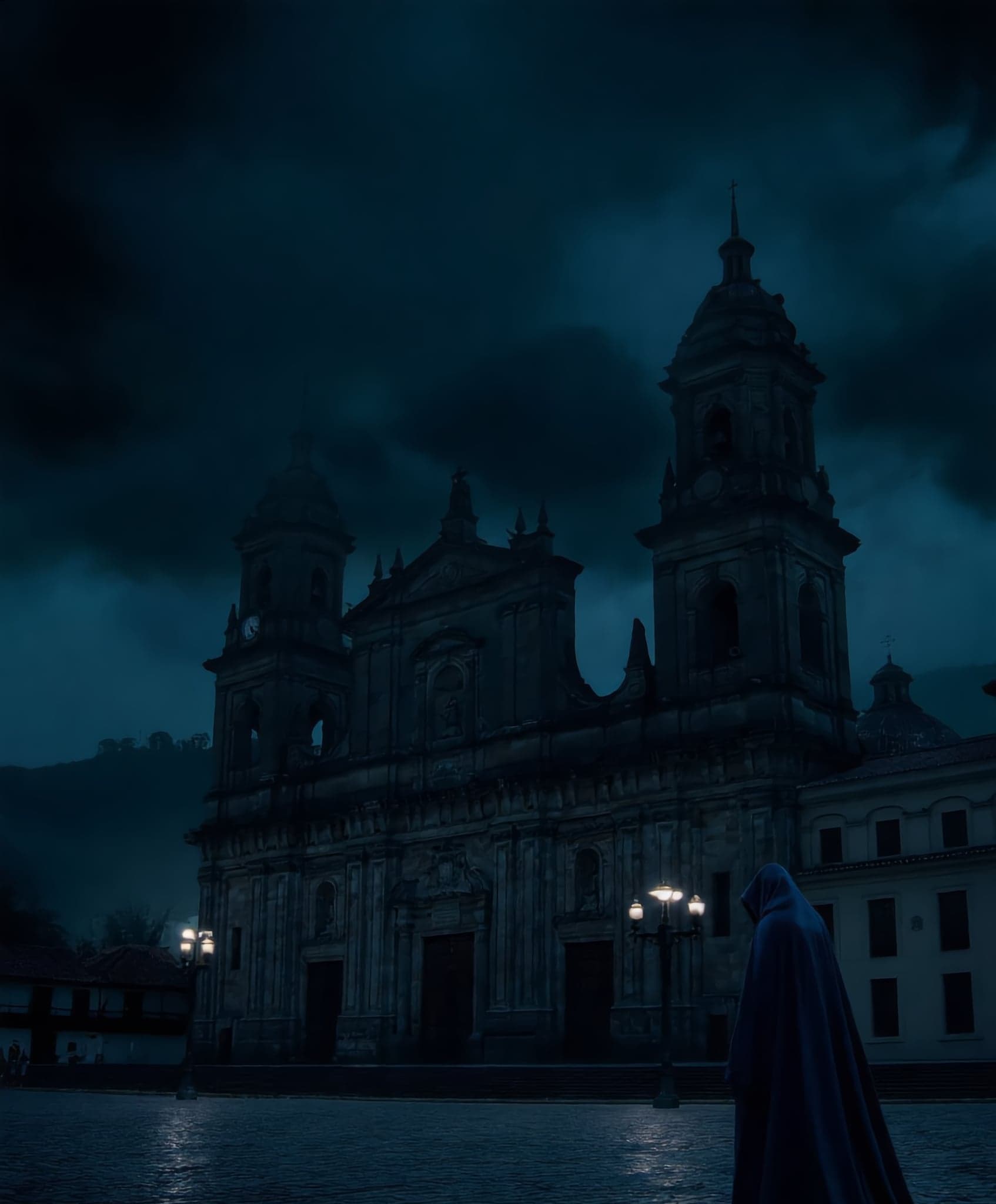
Almost eighty years. Not because no one wanted to finish it, but because Colombia in the nineteenth century was a country in constant war: civil wars, uprisings, changes of government, changes of constitution. Every time there was a political crisis, construction stopped. Eight decades of interruptions. But the result is imposing: that neoclassical façade, those columns, that seriousness. To the west, the Liévano Palace. French style, built between nineteen oh-two and nineteen oh-five. Since nineteen seventy-four it’s been the seat of Bogotá’s Mayor’s Office. So if the city has a problem with the mayor, they know exactly where to come and complain. To the east, the Primatial Cathedral of Colombia. It was designed by Friar Domingo de Petres, a Capuchin architect who came from Spain, and was built between eighteen oh-seven and eighteen twenty-three.
It’s the fourth cathedral to stand on that same spot: the previous three didn’t survive. This one has lasted more than two hundred years, so it seems they finally got it right. And to the north, the Palace of Justice. That building has a story that still hurts. On the sixth of November, nineteen eighty-five, a commando from the M-nineteen guerrilla group stormed the Palace of Justice. Dozens of employees and judges were trapped inside. The army responded with tanks. Literally with tanks, coming in through the doors. For twenty-eight hours the building burned. When it was over, nearly ninety people had died, including several Supreme Court justices. And there are people who went in that day and never reappeared. Their cases are still open.
The building you see now is the one they built afterward. It’s usually said it was inaugurated in nineteen ninety-nine. Four buildings around a square. Each with its own weight. Look at the pigeons too. There are always pigeons. And the corn vendors selling food for them. And the tourists with cameras. And the school students in uniform who come on field trips. And the politicians going in and out of the Capitol without looking at anyone. All of that coexists here, in thirteen thousand square meters that have witnessed the founding of a city, the independence of a nation, executions, civil wars, and one of the greatest tragedies in modern Colombian history. Plaza de Bolívar isn’t just a pretty postcard. It’s the place where Colombia has decided, again and again, who it wants to be.
Frequently asked questions
What is in Bolívar Square in Bogotá?
The National Capitol to the south, the Primate Cathedral to the east and the Palace of Justice to the north. Each building has a story worth more than many museums; LightUp tells you them from the middle of the square.
What is the history of Bolívar Square?
It begins in 1538, when Gonzalo Jiménez de Quesada founded the city with a straw chapel and twelve huts around this square. Since then, everything has passed through here.
What happened at the Palace of Justice in 1985?
On 6 November 1985 an M-19 commando seized the Palace of Justice, on the north side of the square. LightUp tells you about it in front of the building.
Is there an audio guide for Bolívar Square?
Yes. With LightUp you can listen there or at home, in 7 languages: the square where Colombia began and the four buildings around it.
More audio guides in Bogota


Reviews
No reviews yet. Be the first.