I’ll tell you the secrets of Simón Bolívar Metropolitan Park. I guide you here with the map, or you can listen from home. What you see is not what you think, and knowing it is worth it. Some narrations are AI voices and others are real people.
Go there the app walks you there from wherever you are.
Listen there or from home it plays by itself when you arrive, or press play from wherever you are. In your language if it was recorded in it.
Keep discovering the Bogota map has more gems like this one, and you can put them together in a tour.
What you'll discover
113 hectares of green in a city short on public space: the largest park in Bogotá. Its design, its concerts and the man it is named after.
About Simón Bolívar Metropolitan Park
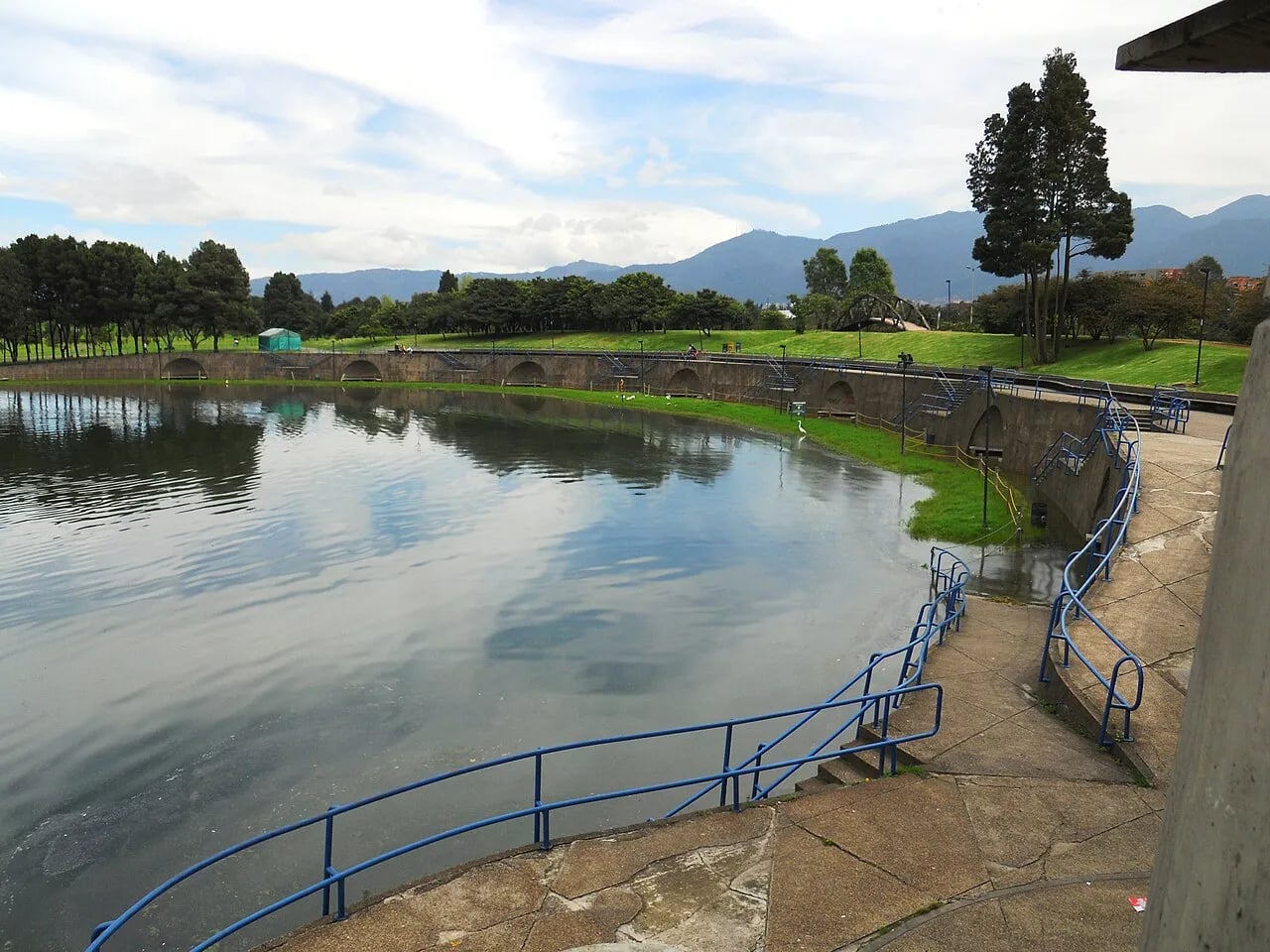
Here at the entrance to Simón Bolívar Park, before you keep walking, find yourself a comfortable spot—a bench, the edge of a fountain, or simply the green grass already starting to stretch out in front of you. This park is in no hurry, and neither are you. You have one hundred and thirteen hectares ahead of you, so it’s best to start out sitting down. one hundred and thirteen hectares. To give you an idea: Central Park in New York covers three hundred and forty-one hectares. El Retiro Park in Madrid, about one hundred and eighteen. Simón Bolívar Park doesn’t reach those dimensions, but in the context of Bogotá—a city built at altitude, with historically scarce public space—its nine hundred and ten thousand square meters of green areas are something close to an urban miracle. But let’s start with the man who gave his name to all of this.
Read the whole storyShow less
Simón Bolívar was born on the twenty-fourth of July, seventeen eighty-three, in Caracas, Venezuela, and died on the seventeenth of December, eighteen thirty, in Santa Marta, Colombia. He was forty-seven years old. In those four and a half decades, it’s said he fought in more than five hundred battles and traveled about ninety thousand kilometers on horseback, and led the independence of six countries: Venezuela, Colombia, Ecuador, Peru, Bolivia, and Panama. He was not a man of rest. The irony that the largest park in Bogotá—a place designed exactly for that, for leisure and calm—bears his name is perhaps unintentional, but it’s not without a certain charm. The story of the park begins, according to some sources, in nineteen sixty-six, when the Capital District acquired the land that makes it up today. These were areas of urban expansion, semi-urbanized plots to the northwest of the historic center, on the edge where the city was still negotiating with the countryside. For years, the plans existed only on paper. Making them a reality was slow.
The decisive push came with Law thirty-one of nineteen seventy-nine, passed by the Colombian Congress to commemorate the bicentennial of Bolívar’s birth. The law ordered the creation of a metropolitan park worthy of that name. The works advanced in stages: the first phase was delivered on the twenty-second of July, nineteen eighty-three, days before the official bicentennial. It’s said that the formal inauguration of the entire complex came on the fifteenth of December, nineteen ninety-one. But before that inauguration, the park had already been the setting for a historic moment.
In August of nineteen sixty-eight, Bogotá hosted the Thirty-Ninth International Eucharistic Congress. Pope Paul the Sixth flew in from Rome—it was the first visit by a pontiff to South America in the entire history of the Catholic Church—to celebrate a massive mass on the grounds that would become the future park. It’s estimated that more than a million people attended. The Eucharistic Pavilion built for that occasion still stands inside the park, now a permanent chapel. Every time you pass by it, remember that at that exact spot, almost sixty years ago, one of the largest crowds in Colombia’s history gathered. The lake is probably the park’s most recognizable feature. It covers about ten or eleven hectares—the equivalent of fourteen soccer fields—and allows activities like canoeing and rowing. The wooden boats painted red and yellow have become a classic image of Bogotá Sundays.
On the shores there are ducks, herons, and sometimes blue gallinules, water birds that many city dwellers have never seen in person until they visit this lake. The outer bike path circles the park’s perimeter with a four-kilometer route. On Sundays, when the city opens up the bike path on its main avenues, this stretch becomes one of the busiest in Bogotá: families on bikes, skaters, runners, older people walking without the noise of traffic. It’s one of those rare hours when Bogotá, a noisy and hectic city, seems to breathe differently.
But the park also has another side: that of big concerts. The Events Plaza has thirty-seven thousand square meters of space and can hold up to eighty thousand spectators. It’s the largest open-air concert venue in Colombia, and one of the largest in Latin America. Some of the biggest names in international music have performed here. Metallica played in this plaza. Iron Maiden. It’s said that Green Day did too. And also Shakira—from Barranquilla, Colombian, one of the country’s most recognizable cultural icons—filled this stage more than once, though that’s not confirmed. But what most defines the park’s musical identity are its free festivals. Rock al Parque, founded in nineteen ninety-five, is the largest open-air rock festival in Latin America and one of the most important in the world in its genre.
It’s held every year in June or July and draws between three hundred thousand and four hundred thousand people over three days. Hip Hop al Parque, created in nineteen ninety-six, is the most important hip hop festival on the continent. And Salsa al Parque, which started in nineteen ninety-seven, is another pillar of Bogotá’s cultural calendar. All free. All here.
Something few visitors notice is that the park also harbors a quiet ecological richness. Among its green areas, wetlands, and gardens grow native species from the Bogotá savanna: weeping willows, acacias, myrtles. On the edges of the lake and the wet zones, more than fifty species of birds have been recorded. Before you continue, take a moment to look at the horizon from where you are. In the distance, the eastern hills, always present above Bogotá. All around you, the scale of the park: paths that branch off, groups of people playing, sleeping, meditating, eating. A park is not just green geometry. It’s the way a city chooses to spend its free time. This is Bogotá’s.
Frequently asked questions
How big is Simón Bolívar Park?
One hundred and thirteen hectares. Central Park in New York covers three hundred and forty-one; in a city as short of public space as Bogotá, this is close to a miracle. LightUp tells you how it came to be.
Which is bigger, Simón Bolívar Park or Central Park?
Central Park: 341 hectares against 113. Even so, it is the largest open-air concert venue in Colombia.
What concerts are held in Simón Bolívar Park?
It hosts Rock al Parque, founded in 1995, the largest open-air rock festival in Latin America. LightUp tells you the park's other sides, from the lake to Pope Paul VI's Mass.
Is there an audio guide for Simón Bolívar Park?
Yes. With LightUp you can listen as you walk or at home, in 7 languages: the park, the lake, the concerts and the man it is named after.