
RAW-Gelände · Audioguía
Escucha la historia de RAW-Gelände
Descarga la app LightUp o escanea el QR con tu móvil. Escucharás este lugar narrado en tu idioma — 7 idiomas disponibles, voces de IA y humanas. Empieza gratis y recorre Berlin a tu ritmo.
Escanea con tu teléfono
Apunta tu cámara al código QR
Historia
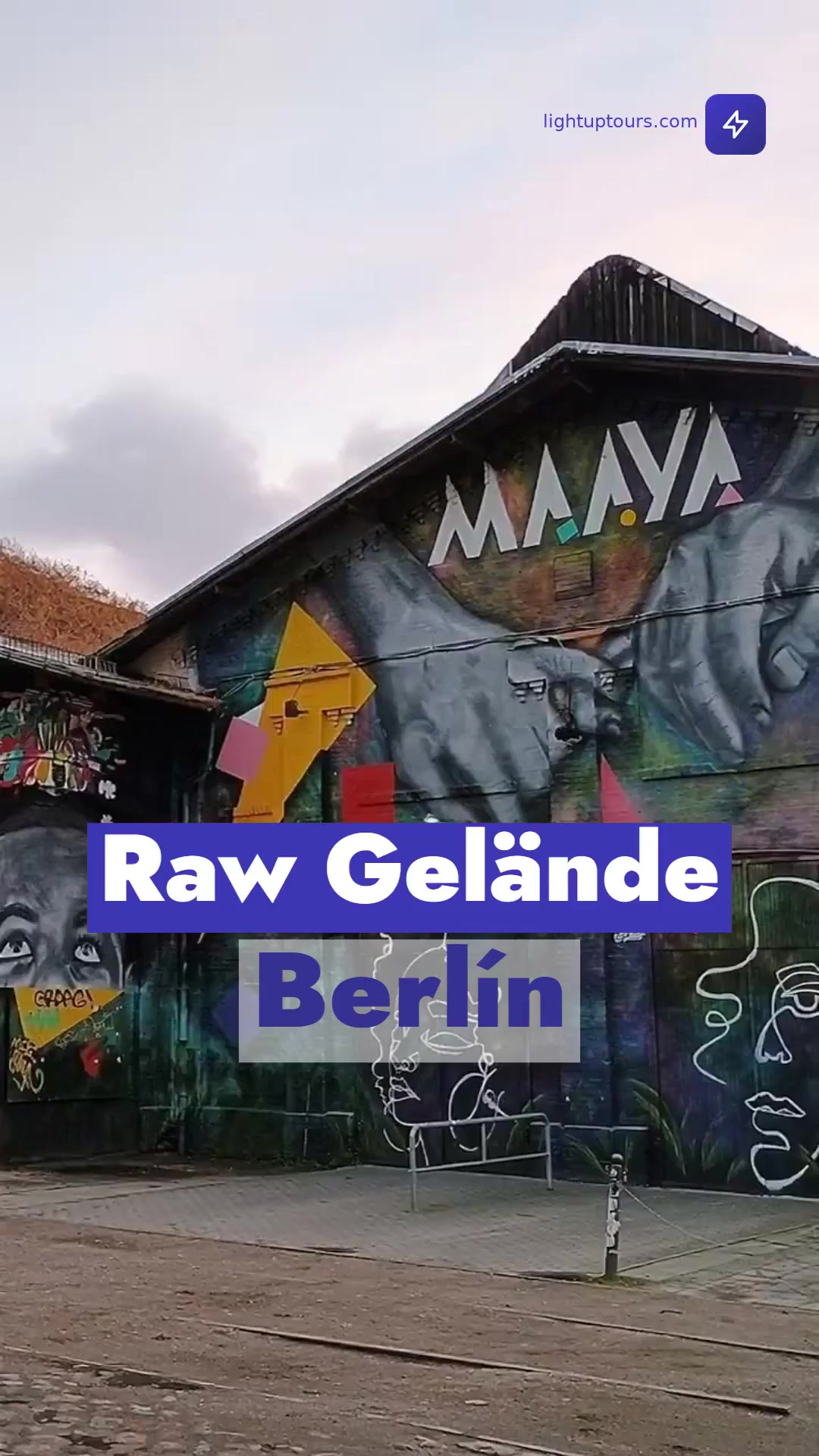
In an alternative corner of Berlin, beneath the graffiti and the techno, sits a secret. One hundred and fifty-seven years of machinery, sweat, and Prussian steel.
October first, eighteen sixty-seven. A railway workshop opens on the edge of the city. The Ostbahn—a direct line from Berlin to Königsberg, the heart of Prussian power.
Today, Königsberg is gone. It's Kaliningrad now, swallowed by Russia. But the tracks that connected them still echo in these walls.
From Friedrichshain and the eastern sprawl of Berlin, men converge. Hundreds of them, drawn by work in a brand new railway workshop.
They repair locomotives, cargo wagons, passenger trains. This is where the Prussian state connects to its eastern empire.
By eighteen ninety-two, they expanded. The workshop grows. More than one thousand workers. The roar of machinery echoes across Friedrichshain every single day.
Then World War One came. The men kept working. They repaired trains for soldiers, for supplies, for an empire that believed it was invincible.
But empires fall. The workshop slowly got abandoned and forgotten. Then, decades later, in the nineties, artists discover it.
They see not ruin, but possibility. What was Prussian becomes punk. What was industrial becomes alive again.
RAW-Gelände is a conversation between centuries. Between those men in eighteen sixty-seven and you, standing here now, listening to the same walls breathe. To hear more stories like this, visit our website.
Visitar RAW-Gelände
- Cómo llegar
- Las paradas más cercanas son S Warschauer Straße (tranvía) a 275 metros y Warschauer Straße (metro/tren) a 292 metros.
- Entrada y precio
- La entrada es gratuita.
- Horario de apertura
- El lugar está siempre abierto.
- Qué ver en el lugar
- Busca la placa conmemorativa en Revaler Straße 99 en memoria de los trabajadores forzados. No te pierdas Der Kegel, un búnker antiaéreo convertido en rocódromo, y el Urban Spree, una galería de arte contemporáneo.
Preguntas frecuentes
¿Qué historia tiene el RAW-Gelände?
El RAW-Gelände fue originalmente un taller de reparación ferroviaria inaugurado en 1867. Durante la Segunda Guerra Mundial, fue utilizado para trabajo forzado. En 1998, artistas y vecinos comenzaron a transformar el espacio en un centro cultural.
¿Qué es Der Kegel?
Der Kegel es un búnker antiaéreo de la Segunda Guerra Mundial, ahora convertido en un rocódromo. Su forma cónica fue diseñada para deflectar bombas, y hoy ofrece 550 metros cuadrados de espacio de escalada.
¿Qué puedo encontrar en el Urban Spree?
Urban Spree es una galería de arte contemporáneo dedicada a las culturas urbanas. Cuenta con un muro exterior de 15 por 8 metros que artistas de graffiti intervienen de forma rotatoria.
¿Qué hay en el Cassiopeia?
Cassiopeia es un club conocido por su variada programación musical que incluye rock, soul, hip hop y reggae. También alberga el Teledisko, una cabina telefónica convertida en la discoteca más pequeña del mundo.
¿Hay un mercado en el RAW-Gelände?
Sí, cada domingo de 9 de la mañana a 8 de la tarde se instala un mercado de pulgas en la entrada del RAW-Gelände.
Más audioguías en Berlin


Comentarios
Aún no hay comentarios.