
Brutalist Apartment Block
Escucha la historia de Brutalist Apartment Block
Descarga la app LightUp o escanea el QR con tu móvil. Escucharás este lugar narrado en tu idioma — 7 idiomas disponibles, voces de IA y humanas. Empieza gratis y recorre Berlin a tu ritmo.
Escanea con tu teléfono
Apunta tu cámara al código QR
Historia
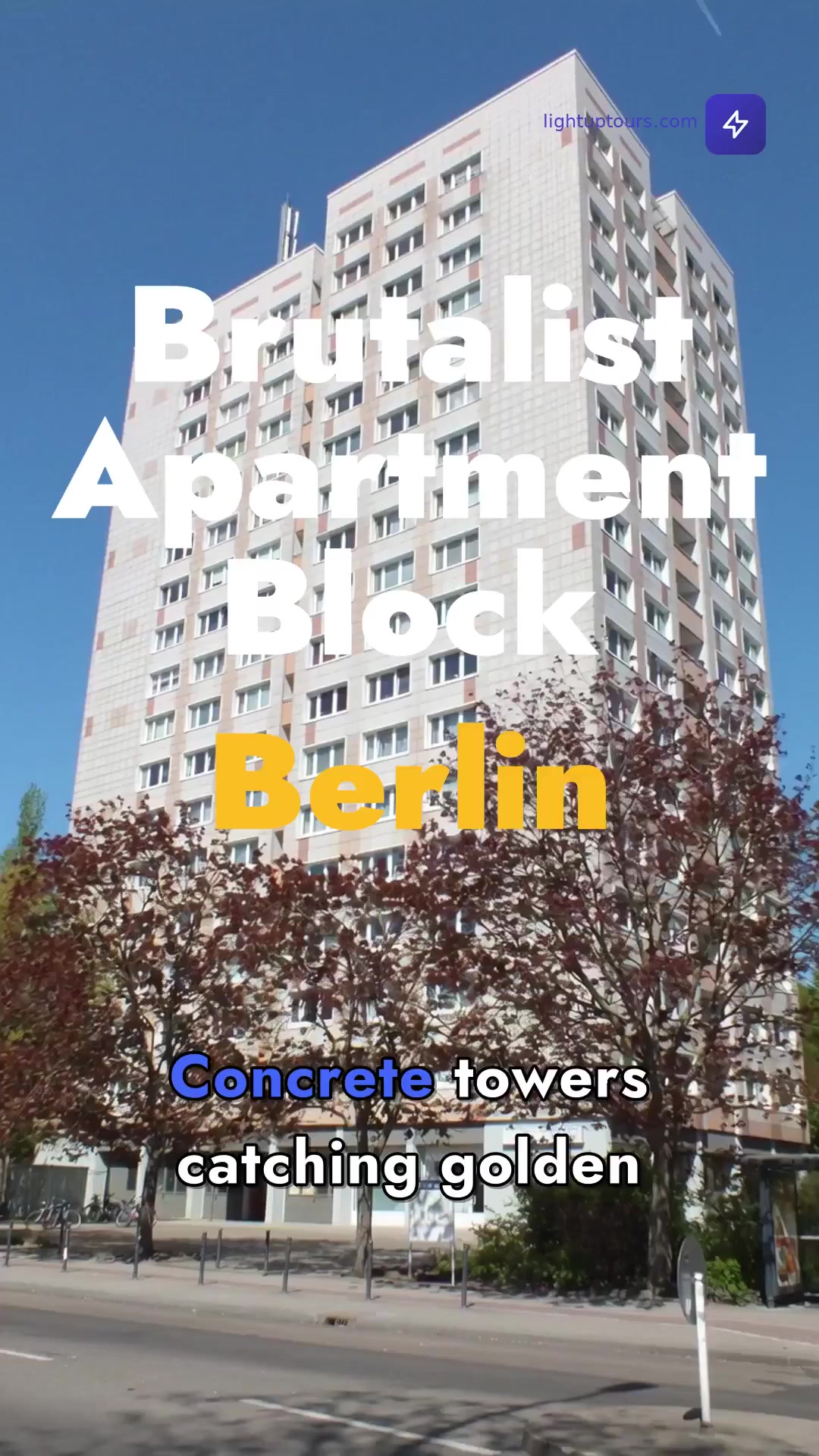
Concrete towers catching golden light. You're standing in the Sewanviertel, East Berlin's first major housing experiment after the Wall went up.
In nineteen sixty-one, the city needed thousands of apartments fast. The government answered with prefabricated slabs, cranes, and speed.
They built the Hans-Loch-Viertel — this neighborhood — between nineteen sixty-one and nineteen sixty-six. Five thousand apartments for fifteen thousand people on eighty hectares.
Look at the grid. Every rectangle is a room. Each slab was poured in a factory, trucked here, and lifted into place.
It was named after Hans Loch, East Germany's finance minister, who had died the year before construction began.
What made people want them? Hot water. A private bathroom. Central heating. Luxuries in East Berlin's crumbling old tenements.
A sixty-one square meter flat — two bedrooms, living room, kitchen, bath — cost one hundred nine marks a month. The average salary was over a thousand.
After nineteen ninety-two, the street names changed. Hans-Loch-Straße became Sewanstraße, named after Lake Sevan in Armenia. The district followed.
Today these blocks have been renovated. New windows, insulation, color. They're still home to thousands — not relics, but living neighborhoods.
These towers held families, birthday parties, arguments, first loves. They're part of Berlin's memory now — proof that everyday life continued, even in a divided city.
Listen to the full audio guide and I'll show you how these slabs became a future people believed in.
Más audioguías en Berlin


Comentarios
Aún no hay comentarios.