LightUp

Oberbaum Bridge · Audio guide

Oberbaum Bridge
Audio guide

Listen to the story of Oberbaum Bridge

Download the LightUp app or scan the QR with your phone. You'll hear this place narrated in your language — 7 languages available, AI and human voices. Free to start, walk Berlin at your own pace.

Story

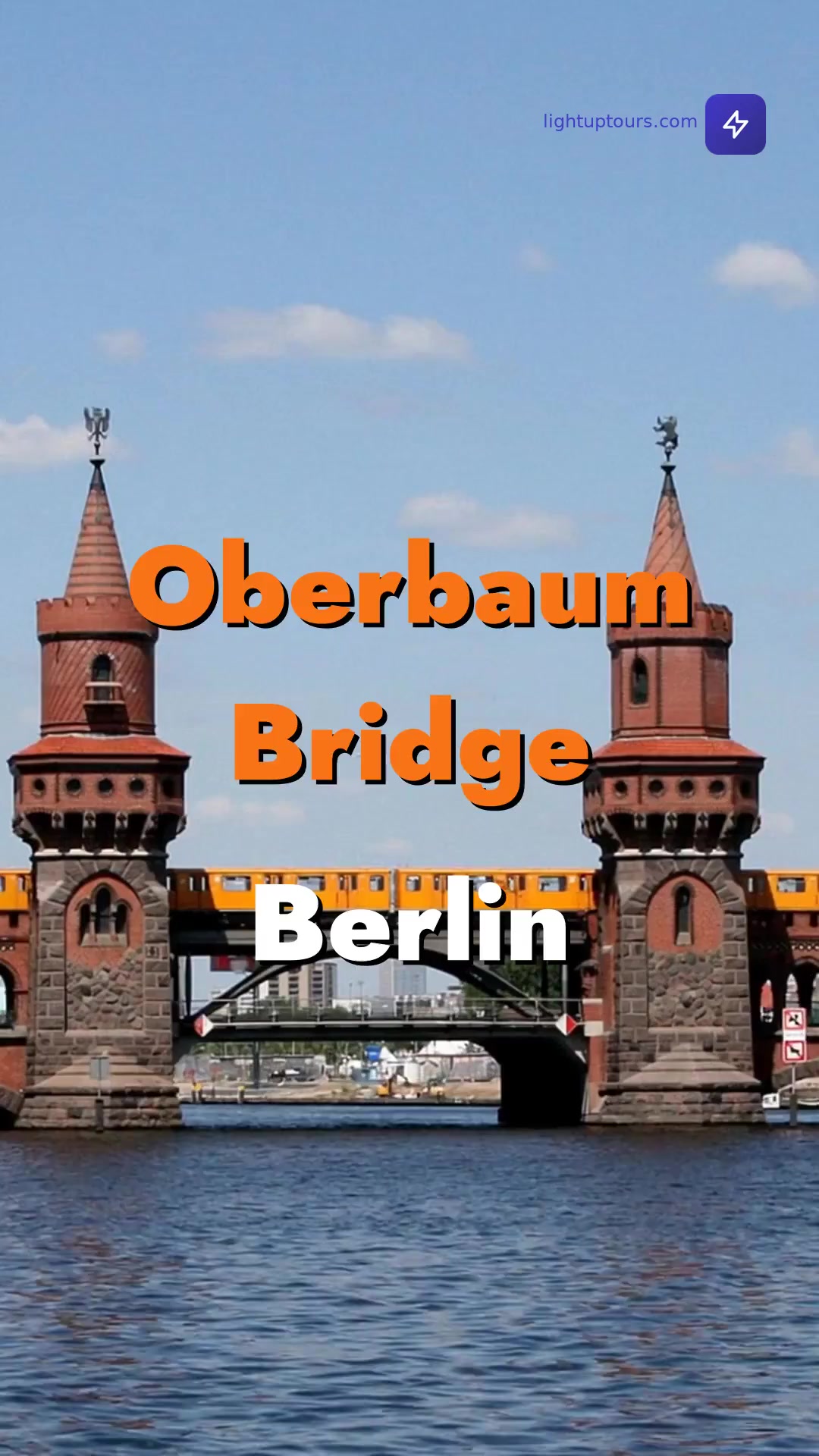
Between Kreuzberg and Friedrichshain, a bridge crosses the Spree. Two red towers rising from the water like a fortress gate. This is the Oberbaum Bridge.

But let me tell you why it's called Oberbaum Bridge. Back in seventeen thirty-two, Berlin wasn't fancy.

A heavy wooden trunk covered in metal spikes dropped across the river every night. To stop smugglers.

In eighteen ninety-four, Berlin wanted something beautiful. Architect Otto Stahn copied the towers from Prenzlau, a medieval city north of Berlin.

He built it like a medieval castle. Red brick. Gothic arches. Crests from eight Brandenburg cities on the walls. A bear for Berlin. An eagle for the state.

In nineteen oh two, the first U-Bahn train crossed. Nineteen passengers. From here to Potsdamer Platz. Berlin's oldest subway line.

Then April nineteen forty-five. The Germans blew up the middle to stop the Red Army. The Red Army crossed anyway.

The bridge sat broken through the Wall years. Then in nineteen ninety-two, Santiago Calatrava, a Spanish architect, put steel between the old red towers.

It reopened on November ninth, nineteen ninety-four. Exactly five years after the Wall fell. The spiked tree is gone. But the gate still stands.

Visiting Oberbaum Bridge

How to get there
The closest bus stop is Oberbaumbrücke, 194 meters away. Other nearby stops include Falckensteinstraße (220 meters), Tamara-Danz-Straße (274 meters), and U Schlesisches Tor (282 meters). The nearest metro/train station is Schlesisches Tor, 306 meters away.
Entry and price
Entry is free.
Opening hours
The site is always open.

Frequently asked questions

What is the historical significance of the Oberbaum Bridge?

The Oberbaum Bridge is a symbol of German reunification, linking the districts of Friedrichshain and Kreuzberg, which were separated by the Berlin Wall.

What architectural style is the Oberbaum Bridge built in?

The bridge was designed in the North German Brick Gothic style by Otto Stahn, featuring seven red brick arches and two octagonal towers.

What happened to the Oberbaum Bridge during World War II?

In April 1945, retreating German troops destroyed the central section of the bridge to slow the advance of the Red Army.

What is the significance of the neon signs on the bridge?

Installed in 1997, the neon signs play a continuous game of rock, paper, scissors, symbolizing the historical conflict between two political systems at the bridge.

What can be seen from the Oberbaum Bridge?

From the bridge, you can see the Molecule Men sculpture in the Spree, representing unity, and the contrasting architectural styles of the bridge itself.

What was the Gemüseschlacht?

The Gemüseschlacht was a vegetable battle tradition from 1998 to 2013, where residents of Friedrichshain and Kreuzberg would meet on the bridge for a playful food fight.

Free Entry
GET IT ON
Google Play
App Store
Coming Soon

Comments

No comments yet.