La Puerta Falsa
 Por © ProtoplasmaKid / Wikimedia Commons, CC BY-SA 4.0
Scan it with your phone
Point your camera at the QR code
La Puerta Falsa: Tamales Since 1816Audio guide
 Told byBogotours
I’ll tell you the secrets of La Puerta Falsa. I guide you here with the map, or you can listen from home. What you see is not what you think, and knowing it is worth it. Some narrations are AI voices and others are real people.
€0.995 min AI voiceFood
Audio in:EnglishSpanishGermanFrenchItalianPortugueseChinese
How it works
- Go there
the app walks you there from wherever you are. - Listen there or from home
it plays by itself when you arrive, or press play from wherever you are. In your language if it was recorded in it. - Keep discovering
the Bogota map has more gems like this one, and you can put them together in a tour.
What you'll discover
In the heart of Bogotá, on a corner of the cathedral, there exists a restaurant so old that locals know it by heart. The False Door La Puerta Falsa.
Tamales wrapped in plantain leaves,
steaming ajiaco, fried delicacies that have fed generations. But few know the truth hidden in its walls.
Eighteen sixteen. Josefa Caicedo—a devout woman. She prepares refreshments for the feast at the cathedral, but only for those she chose to serve. The priest said she had no right to decide. She knew she deserved that right.
So she opened her own door. Her husband's name on the papers—because women had no right to property, no right to decide. But she chose where the knife went, what went in the pot, who ate.
It has witnessed the Bogotazo, revolutions, fires in the plaza next door. Politicians, artists, strangers—all crammed into twenty square meters eating ajiaco.
The walls are narrow, the tables worn. But nobody comes for comfort. They come for the food—that same food, that same fire in the kitchen that she started.
Today, no one knows who she was. Her name is gone. But her act of defiance still breathes in every bowl that leaves that kitchen.
Visit La Puerta Falsa in Bogotá. I'll take you there and show you around.
About La Puerta Falsa
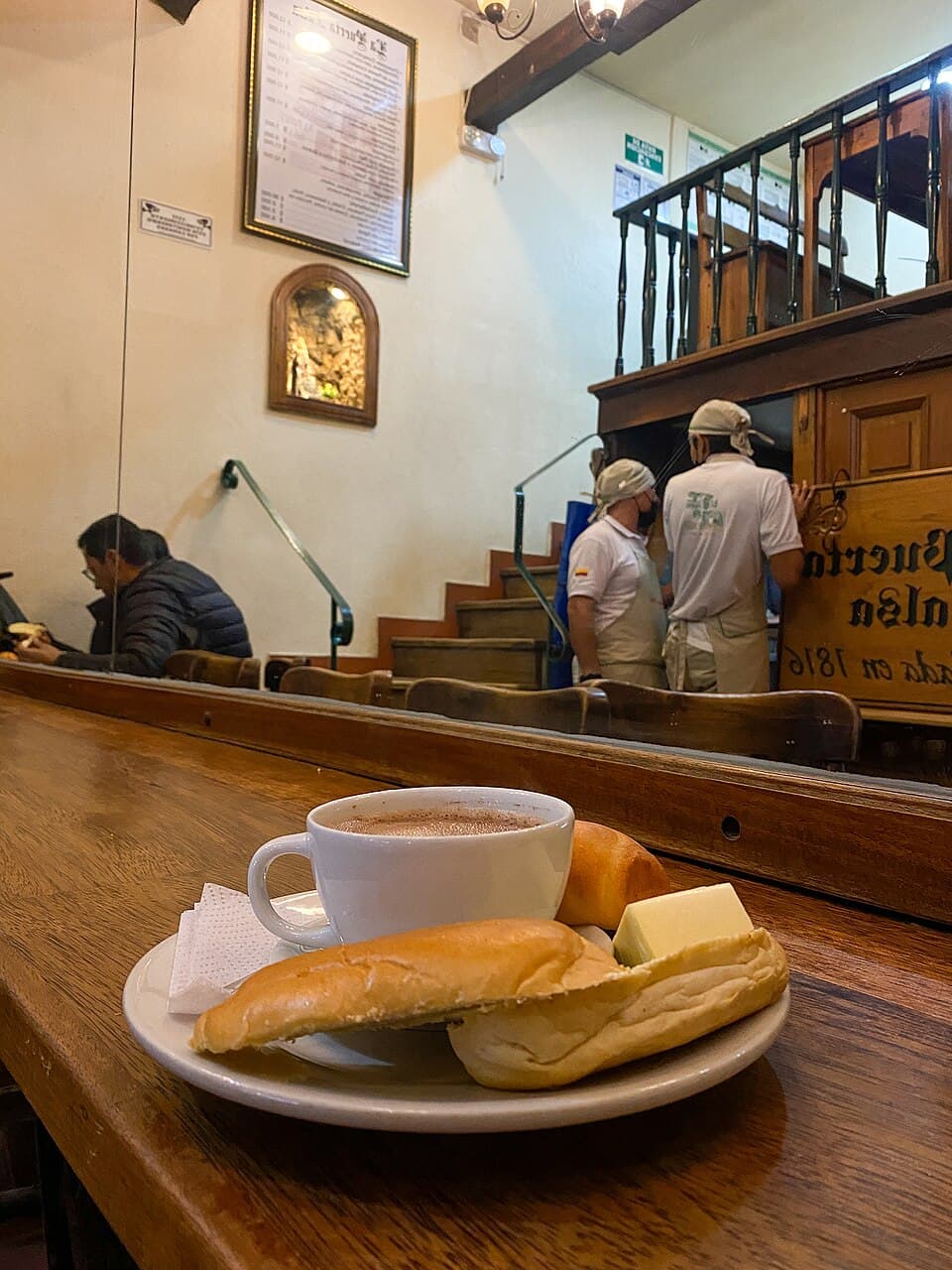
11th Street with 6th Avenue, north side of the Cathedral. The same wooden beams on the ceiling. The smell of chocolate with cheese. This is La Puerta Falsa, the oldest restaurant in Colombia. More than two hundred years in the same place, the same family, the same recipes. If you want to understand how Bogotá survived everything, start here. On July 16, 1816, Josefa Caicedo argued with the parish priest of the Cathedral. She wanted to prepare snacks for the Virgin of Carmen and distribute them. The parish priest Juan Bautista Sacristán y Galiano told her no. Josefa did it anyway. She set up her aguapanelería in front of one of the side doors of the Cathedral. At that time, women couldn't own property. Josefa put the business in her husband José Joaquín Cortes' name and stayed in the kitchen. He signed, she did the work. Those small doors that are not the main entrance to the cathedral are called false doors. The place took its name from there. The door itself no longer exists, demolished in some restoration. The original name of the place was La Chozna. But people started calling it the aguapanelería of the false door. The nickname stuck and stayed forever. The land had belonged to nuns since the 16th century. When Josefa died, the place passed to the great-great-grandmother of the current owners. A legal battle with the church began. A ruling left the place in the hands of Julia Herrera, a posh relative who entrusted it to her cousins. The name of the great-great-grandmother was lost among the memories. On May 20, 1900, a fire on 10th Street consumed the Arrubla galleries and the Liévano palace. La Puerta Falsa remained open. On April 9, 1948, Jorge Eliécer Gaitán, the most beloved popular leader in the country, was assassinated. Bogotá burned with fury. The owners couldn't close because the door was misaligned. They stayed to guard while the city crumbled. The parish priest of the Cathedral entrusted them with the sacred ornaments to protect them from looting. The next day they brought out the food and fed the people who had spent the night sheltered in the temple. Carlos Sabogal, one of the owners, went up to the second floor when the crowd tried to burn the Cathedral's scaffolding. He took the fire hose and sprayed water from there. Bullets came from everywhere. The restaurant saved part of the Cathedral that night. No one knows. At one time it operated 24 hours to serve the staff of La República, El Tiempo, and El Espectador's printing presses. The center didn't sleep, and neither did they. In 2002 the place caught fire. With it, the photographs and manuscripts that told the story were burned. They rebuilt it. The recipes survived in memory. When the mother of the current owners died, several employees who knew the recipes resigned. The peto, one of the most beloved dishes, was lost. They were saved by Pepita, the ex-wife of Carlos Sabogal. She memorized the recipes before her ex-mother-in-law died. Today she continues to collaborate in the restaurant. The tamales are prepared in Prado, Tolima, although the flavor is capitalino. The mix includes soaked corn, dried peas, carrot, chicken, sausage, bacon, and pork. Each family member tastes the mix before cooking it. The chocolate is made with water, not milk. Changua is served for breakfast. The ajiaco has been the same for over a hundred years. During the pandemic, it was on the verge of closing forever. The people of Bogotá saved it by ordering delivery. In 2023, Taste Atlas recognized it as one of the most emblematic places in the world. Out of 23,751 restaurants, they selected 150. La Puerta Falsa was there. The clientele is generational. Aracely Torres, 83 years old, recounts the afternoons she spent there with her friends. Camila González celebrated every birthday there since she was four years old. Today it is the seventh generation of the same family that keeps the recipes. What started as a fight with a priest became the living memory of Bogotá. Order the chocolate with cheese. It's the most Bogotá thing there is.
Visiting La Puerta Falsa
- How to get there
- The closest bus stop is Biblioteca Luis Ángel Arango, located 317 meters away.
- Entry and price
- Entry is free.
- Opening hours
- The place is always open.
Frequently asked questions
What is the historical significance of The False Door?
The False Door, originally known as La Chozna, has been a part of Bogota's history for over two hundred years. It played a role during the assassination of Jorge Eliécer Gaitán in 1948, where it helped protect the cathedral's sacred ornaments.
What should I try when visiting The False Door?
Visitors should try the chocolate with cheese, which is a traditional Bogotano treat. The restaurant is also known for its tamales and ajiaco, which have been made with the same recipes for over a century.
What happened to The False Door during the 2002 fire?
In 2002, a fire destroyed photographs and manuscripts detailing the restaurant's history. However, the recipes survived in the memory of Pepita, the ex-wife of one of the owners, who helped preserve them.
What notable events did The False Door survive?
The False Door survived the 1900 fire that consumed the galleries of Arrubla and the palace of Liévano, as well as the 1948 riots following the assassination of Jorge Eliécer Gaitán.
What nearby attractions can I visit?
Nearby attractions include several chapels such as Capilla de Nuestra Señora de los Dolores and Capilla de San Juan Nepomuceno, as well as the Catedral Primada de Bogotá, all within a short walking distance.
More audio guides in Bogota

Reviews
No reviews yet. Be the first.