Neptune Fountain
 CC BY-SA 3.0
Scan it with your phone
Point your camera at the QR code
Neptune Fountain Berlin: Bernini-Style BaroqueAudio guide
 Told byLightUp
I’ll tell you the secrets of Neptune Fountain. I guide you here with the map, or you can listen from home. What you see is not what you think, and knowing it is worth it. Some narrations are AI voices and others are real people.
Free5 min AI voiceHistory
Audio in:EnglishSpanishGermanFrenchItalianPortugueseChinese
How it works
- Go there
the app walks you there from wherever you are. - Listen there or from home
it plays by itself when you arrive, or press play from wherever you are. In your language if it was recorded in it. - Keep discovering
the Berlin map has more gems like this one, and you can put them together in a tour.
What you'll discover
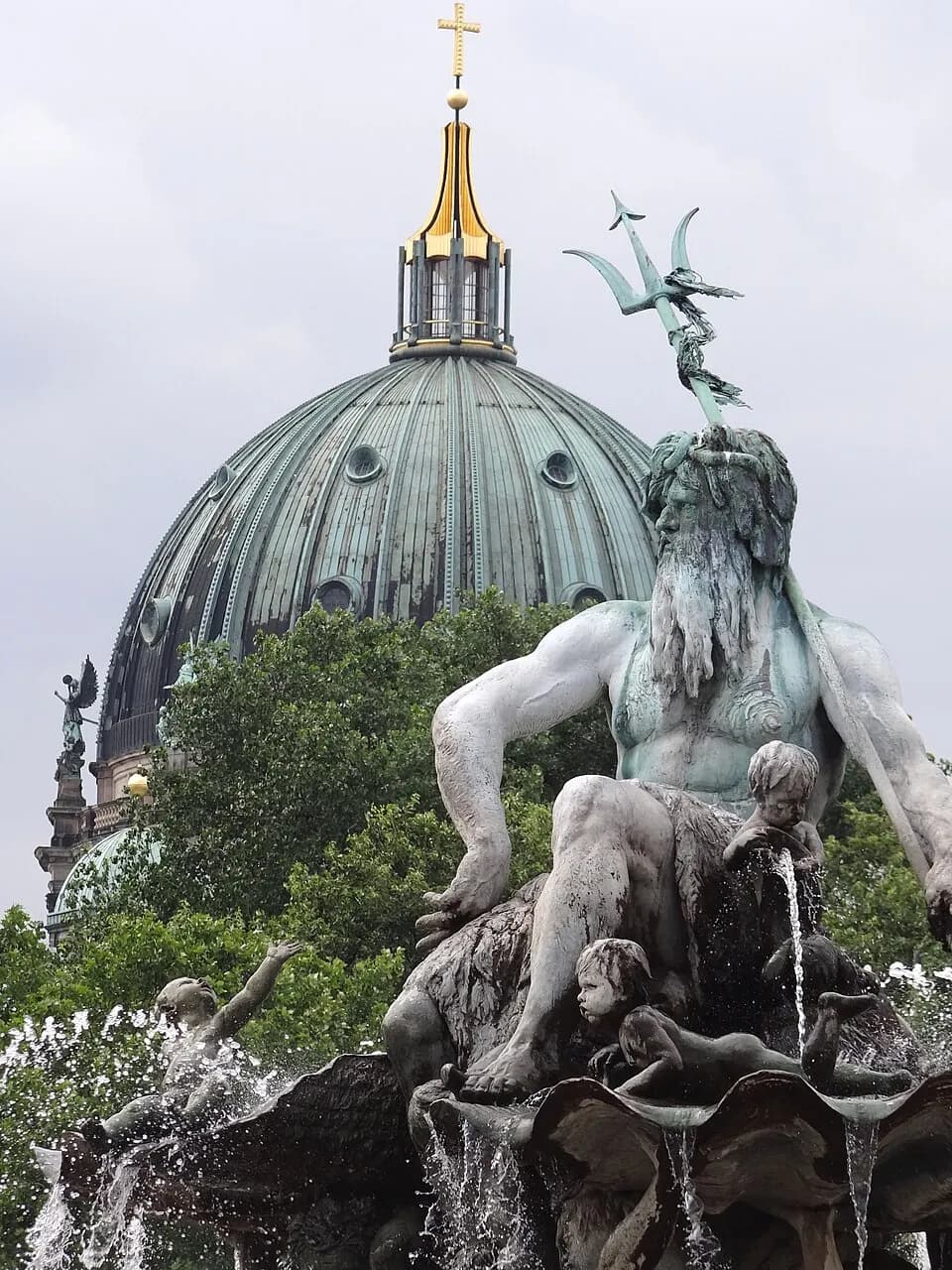
Four women surround the god of the sea in the heart of Berlin. Each represents a river, but one of them hides a detail that caused a scandal.
This fountain was a poisoned gift. The one who commissioned it and the one who received it hated each other, and the sculptor left clues in the bronze.
Neptune has been keeping this secret for over a century. Follow me to the fountain and I'll show you where to look.
About Neptune Fountain
Find a bench, or sit on the edge of the fountain if you can. The story of what lies before you is more complicated than it seems.
Read the whole storyShow less
The fountain you see before you was not always here. Looking at it, surrounded by open space between the Red Town Hall and the Marienkirche, it seems permanent. But it arrived at this location just fifty years ago, after an eighty-year journey, a war, eighteen years in storage, and a political decision by the East German government.
The fountain was built between eighteen eighty-eight and eighteen ninety-one by the sculptor Reinhold Begas, the most important of the German neobaroque style. The commission came from the Berlin town hall as a gift for Kaiser Wilhelm II. Its place was the Berlin Palace Square, the Berliner Stadtschloss, the imperial residence in the heart of the city. There it stood in front of the palace facade for sixty years.
Begas was directly inspired by Bernini and the great baroque fountains of Rome: the scale, the drama, the accumulation of figures. The result is ten meters high and eighteen in diameter. Neptune dominates the center, enthroned on a huge shell, carried by four tritons, with the trident raised. At his feet are crocodiles, turtles, crabs, octopuses, a snake. The Berliners called it from the beginning Forckenbecken, a play on words between Forke, meaning pitchfork or trident, and the name of the mayor at the time, Max von Forckenbeck. The trident looks like a giant fork and the mayor's surname sounded like a bowl. Berlin humor.
Around the edge of the basin are four female figures, each sitting on an element that identifies her. They are four rivers: the Elbe, with ears of corn and agricultural fruits. The Rhine, with fishing nets and vine leaves. The Oder, with animal skins and leathers. And the Vistula, with logs of wood, a symbol of the eastern forest trade. Together, these four rivers traced in eighteen ninety-one the complete map of the Prussian territory, from the Rhine vineyards in the west to the Polish forests in the east. The Vistula today does not pass through Germany. It flows through Poland. The fountain is also a map of a vanished empire.
The origin lies in the material of the basin. The original was made of unique, irreplaceable red Swedish marble. When the East German government dismantled the fountain in nineteen fifty-one, that marble was lost. What you see today is a red granite basin, installed in nineteen sixty-nine. It has never been much mentioned. Tourists assume what they see is original. Only the basin is not.
The dismantling of nineteen fifty-one is linked to one of the most destructive decisions in European urban planning of the twentieth century. In nineteen fifty, the GDR government decided to demolish the Berlin Imperial Palace. The building had survived the war with repairable damage, but for the new socialist state, it was an unacceptable symbol of Prussian militarism. They blew it up. With the palace gone, the fountain was left without context, without a square, without meaning in that place. The figures were stored for eighteen years. In nineteen sixty-nine, the GDR government restored them at the Lauchhammer foundry, filled in what was missing, installed the new granite basin, and relocated the fountain here, in the civic center of East Berlin, surrounded by socialism, several hundred meters from where it was born.
Since the Berlin Palace was rebuilt as the Humboldt Forum and opened its doors in two thousand twenty-one, the conversation about the fountain returned. Historical preservation groups have been arguing for years that it belongs back in the Schlossplatz, that the fountain needs the palace as a backdrop to function visually. The Berlin government responded in two thousand twenty-three with a clear stance: the fountain stays where it is. A modern fountain will go in the Schlossplatz.
The fountain has thus been trapped between two versions of Berlin: the imperial, for which it was built, and the socialist, which repurposed it. And meanwhile, it remains here, with Neptune looking towards the television tower, his tritons carrying him towards no particular palace.
Visiting Neptune Fountain
- How to get there
- The closest stop is U Rotes Rathaus bus stop, 80 meters away. The Rotes Rathaus metro/train stop is 94 meters away.
- Entry and price
- Entry is free.
- Opening hours
- The Neptune Fountain is always open.
Frequently asked questions
What is the history of the Neptune Fountain?
The Neptune Fountain was created by sculptor Reinhold Begas between 1888 and 1891 as a gift for Kaiser Wilhelm II. Originally located in front of the Berliner Stadtschloss, it was moved to its current location in 1969 after being stored for 18 years.
What are the main features of the Neptune Fountain?
The fountain stands 10 meters high and 18 meters in diameter. It features Neptune enthroned on a large shell, surrounded by tritons and various sea creatures. Four female figures around the edge represent the rivers Elbe, Rhine, Oder, and Vistula.
Why was the Neptune Fountain moved?
The fountain was moved after the Berliner Stadtschloss was demolished by the East German government in 1950. It was relocated to its current site in 1969, as part of a civic center in East Berlin.
What material is the Neptune Fountain made of?
Originally, the fountain's basin was made of unique Swedish red marble, which was lost during its dismantling in 1951. The current basin, installed in 1969, is made of red granite.
Is there anything nearby worth visiting?
Nearby attractions include the Marienkirche and the Rotes Rathaus. The area also features the Marx-Engels-Forum and the Humboldt Forum, which opened in 2021.
More audio guides in Berlin

Reviews
No reviews yet. Be the first.