Anne Frank Center
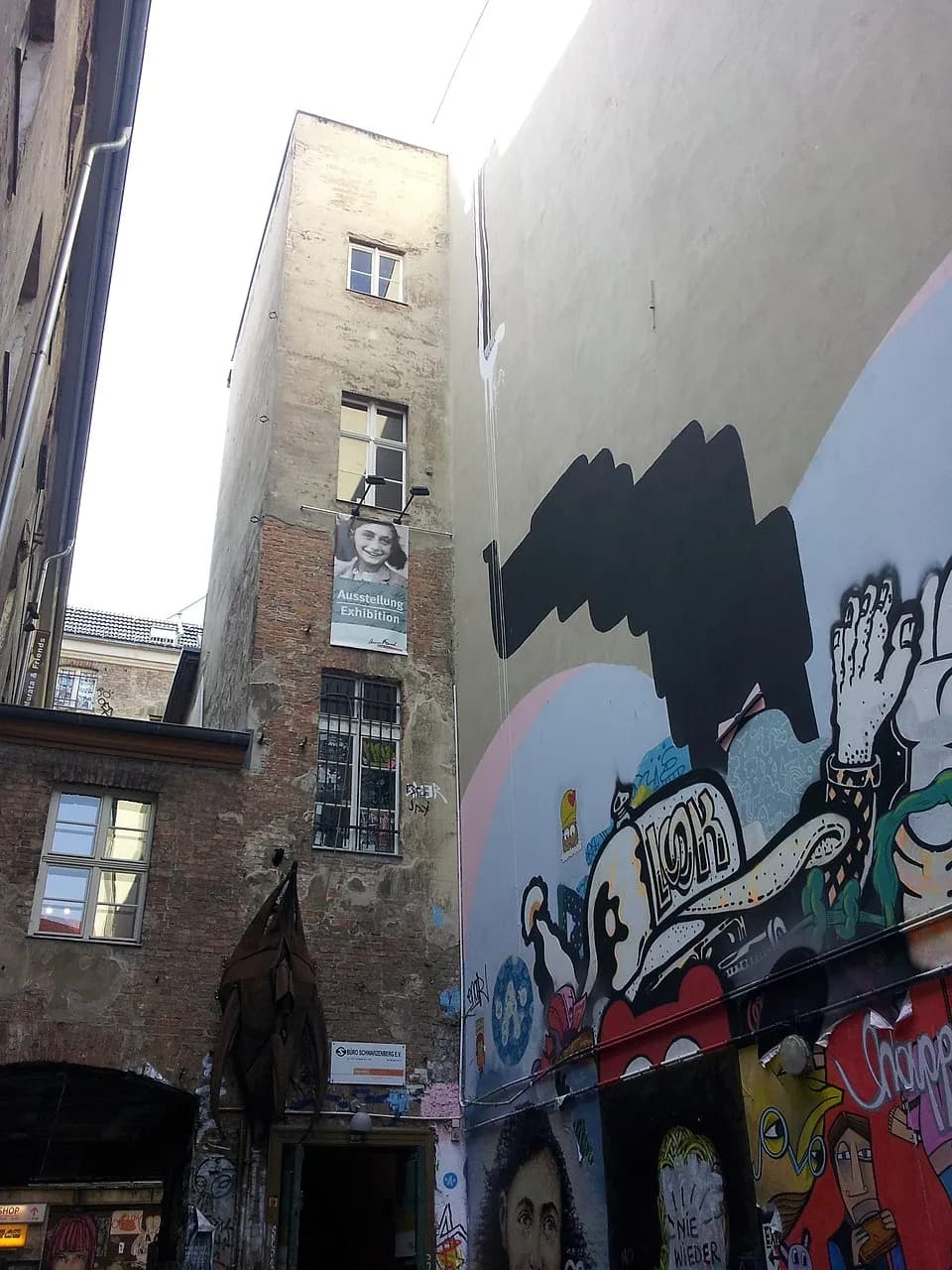 By SPKrautkrämer - Own work, CC BY-SA 3.0
Scan it with your phone
Point your camera at the QR code
Anne Frank in Berlin: Anne Frank ZentrumAudio guide
 Told byLightUp
I’ll tell you the secrets of Anne Frank Center. I guide you here with the map, or you can listen from home. What you see is not what you think, and knowing it is worth it. Some narrations are AI voices and others are real people.
Free8 min AI voiceHistory
Audio in:EnglishSpanishGermanFrenchItalianPortugueseChinese
How it works
- Go there
the app walks you there from wherever you are. - Listen there or from home
it plays by itself when you arrive, or press play from wherever you are. In your language if it was recorded in it. - Keep discovering
the Berlin map has more gems like this one, and you can put them together in a tour.
What you'll discover
In a Berlin courtyard covered in graffiti, a portrait of Anne Frank smiles back. Below it, an entrance to a center that asks one question.
Why a museum about Anne Frank in Berlin? She wasn't born here, never lived here, never died here.
But the regime that turned her into a refugee, then a fugitive, then a number on a deportation list was born here.
The Anne Frank Zentrum opened in nineteen ninety-four. But it stands in the Scheunenviertel, Berlin's old Jewish quarter—and that choice of location is everything.
The Scheunenviertel was where Jewish migrants fleeing pogroms in Russia and Poland arrived. Many tried to emigrate to America, but attempts usually failed due to lack of money.
Up to seventy percent were Eastern Jews, often strictly orthodox. A lively Jewish culture flourished here with prayer houses, stores and institutions. But it was also poor, overcrowded, a neighborhood the regime would soon hunt.
When the Nazis came to power in nineteen thirty-three, many Jews from the Scheunenviertel did not survive.
Those without money, without citizenship papers, without a way out — they became trapped inside the city that once welcomed them.
The center stands today in that absence. A memorial to those who could not leave.
Listen to the full guide and I'll walk you through her story and show you why Berlin chose to remember her here.
About Anne Frank Center
Before entering, take a moment. Find a bench, a chair, or simply lean wherever you can. The story of this museum begins with a question worth listening to calmly. You might be wondering what a museum about Anne Frank is doing in Berlin. She wasn't born here, didn't live here, didn't die here. She was born in Frankfurt, hid in Amsterdam, and died in Bergen-Belsen. So why here? Because the regime that persecuted her was born here. Berlin was the capital of the government that turned a German girl into a refugee, then into a clandestine, then into a deported number. The neighborhood where you are standing, the Scheunenviertel, was the heart of Jewish working life in Berlin: the neighborhood of Yiddish theater, Yiddish press, thousands of Eastern European Jewish families. They came here seeking a better life. That world was completely destroyed. Nothing of it survived. Being here, in this courtyard, is already being at the center of that absence. The Anne Frank Zentrum is the official partner in Germany of the Anne Frank House in Amsterdam. It is not a replica of that museum. It is an educational center created for schools and young people to understand how discrimination works: how it starts, how it becomes normalized, how it progresses. It is the only exhibition about Nazism in Berlin specifically designed for children and families. And who was Anne Frank? A girl born in Frankfurt on June 12, 1929. When Hitler came to power in January 1933, her family fled to the Netherlands. Anne was four years old. In Amsterdam, she lived a relatively normal childhood: she went to school, had friends, was known for being funny, talkative, and very direct. All that changed when the Nazi occupation also reached Holland. The anti-Semitic laws kept piling up: first the mandatory yellow star, then the ban on using public transport. From going to the cinema, from going to the beach, from studying in non-Jewish schools. In July 1942, at thirteen, Anne went into hiding with her family. In a secret annex behind her father's business at Prinsengracht 263. With them, four other people hid: Hermann and Auguste van Pels with their son Peter, and the dentist Fritz Pfeffer. Eight people in a space of less than fifty square meters. During the day, they couldn't make noise to avoid alerting the warehouse employees below who knew nothing. They couldn't look out the windows. They couldn't run water while the business was open. They lived like this for twenty-five months. Four office collaborators supported them: they brought them food, clothes, books, news from outside. One of them was Miep Gies. Without them, the eight wouldn't have survived a week. Anne had been writing in her diary before entering the hideout, but inside, writing became central. She wrote with an imaginary address: her entries were directed to a friend named Kitty. In 1944, she heard on the clandestine radio that a Dutch minister in exile was asking people to keep their diaries to document what was happening. Anne began to rewrite and edit her own entries with the idea that they might be published one day. On August 4, 1944, between ten and eleven in the morning, the German security police stormed the hideout. The eight were arrested. Who betrayed them? It's one of the most painful questions of this story. And it has an uncomfortable answer: we don't know. The case has been open for eighty years. Because that's how dictatorships work. Fear is not only exercised by those in power. It's also exercised by neighbors, acquaintances, coworkers. Anyone can be an informant. No one can be completely trusted. That permanent distrust is one of the most effective tools of authoritarianism. You don't need to monitor everyone if you get everyone to monitor each other. In 2016, a research team published a theory that the raid might have been an accidental consequence. An accidental consequence of an investigation into ration card fraud, not a direct denunciation. That hypothesis has also been questioned. There are several suspects with names and surnames. None have been proven. The mystery remains. The eight were sent to the Westerbork transit camp. On September 3, 1944, on the last transport that left Westerbork for Auschwitz-Birkenau, they were deported. Of the eight, only Otto Frank survived. Edith died in Auschwitz in January 1945. Hermann van Pels died in the gas chambers. Auguste van Pels died under unknown circumstances. Peter van Pels died on a death march. Fritz Pfeffer died in the Neuengamme camp. In November 1944, Anne and Margot were transferred to Bergen-Belsen. Both died of typhus. Anne was fifteen years old. For decades, it was believed she died in March 1945, a few weeks before the British army liberated the camp on April 15. In 2015, investigations by the Anne Frank House revised that date and moved it to February. Otto Frank was liberated from Auschwitz on January 27, 1945. When he returned to Amsterdam and learned that his daughters had died, Miep Gies gave him the diary. She had picked it up from the floor on the day of the raid and had kept it without opening it. Hoping to return it to Anne. Otto compiled it, edited it, and sought a publisher. Several rejected it. Finally, on June 25, 1947, it appeared in Dutch as Het Achterhuis, the Secret Annex. Today it is translated into more than seventy languages and is one of the most read books in history. For decades, neo-Nazi groups insisted that the diary was a forgery. Otto Frank spent years suing them. The courts repeatedly ruled in his favor. In 1986, the Netherlands Institute for War Documentation published a complete forensic analysis. Of the paper, ink, and writing, confirming its authenticity. Those accusations still circulate on the internet. The Anne Frank Zentrum directly addresses them within its exhibition. Along with examples of current anti-Semitism. That is the raison d'être of this place: not to commemorate the past as something finished, but to connect it with what continues to happen.
Visiting Anne Frank Center
- How to get there
- The closest stop is S Hackescher Markt tram stop, 65 meters away.
- Entry and price
- Entry costs 6 for adults.
- Official website
- Visit the official website at https://www.annefrank.de/ausstellung-berlin/ihr-besuch/tickets-und-preise#/ for more information.
Frequently asked questions
Why is there an Anne Frank Center in Berlin?
The Anne Frank Center in Berlin exists because the regime that persecuted Anne Frank originated in this city. It aims to educate about discrimination and its progression, connecting the past with present issues.
What is the focus of the Anne Frank Center in Berlin?
The center is an educational facility designed to help schools and young people understand discrimination, specifically how it starts, normalizes, and advances. It is the only exhibition on Nazism in Berlin specifically designed for children and families.
What should I not miss at the Anne Frank Center?
The exhibition directly addresses accusations against the authenticity of Anne Frank's diary and connects historical antisemitism with current examples, highlighting the ongoing relevance of these issues.
What is nearby the Anne Frank Center?
Nearby, you can find the KPD 1921-26, Dead Chicken Alley, and several Stolpersteine (stumbling stones) commemorating the Salinger family, all within 24 meters.
More audio guides in Berlin



Reviews
No reviews yet. Be the first.