Neues Museum
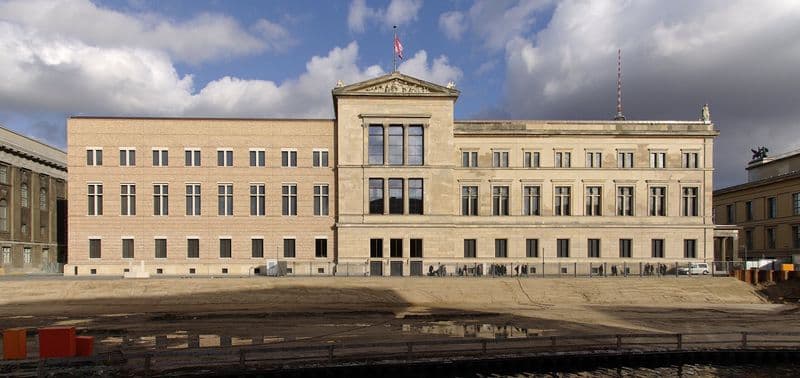 Von Janericloebe - Eigenes Werk, Gemeinfrei
Scan it with your phone
Point your camera at the QR code
Nefertiti in Berlin: the Neues MuseumAudio guide
 Told byLightUp
I’ll tell you the secrets of Neues Museum. I guide you here with the map, or you can listen from home. What you see is not what you think, and knowing it is worth it. Some narrations are AI voices and others are real people.
€0.995 min AI voiceArt
Audio in:EnglishSpanishGermanFrenchItalianPortugueseChinese
How it works
- Go there
the app walks you there from wherever you are. - Listen there or from home
it plays by itself when you arrive, or press play from wherever you are. In your language if it was recorded in it. - Keep discovering
the Berlin map has more gems like this one, and you can put them together in a tour.
What you'll discover
This museum was destroyed in the war and lay in ruins for sixty years. When they rebuilt it, they deliberately left the scars.
The most famous woman in Berlin lives here. She is three thousand three hundred years old and has one eye she never had. No one knows why.
The Neues Museum blends destruction and beauty like no other place. Let's explore it together and I'll tell you about its scars.
About Neues Museum
Before entering, take a moment. Find a bench or a step. The building in front of you has its own story, before you start seeing what's inside.
Read the whole storyShow less
The Neues Museum is not just a museum. It's a building that tells its own story before you enter to see any collection. The scars are on the walls, on the columns, on the ceilings that are interrupted without explanation. And that's exactly what the architect intended.
The building was designed by Friedrich August Stüler and built between 1843 and 1855, commissioned by King Frederick William IV of Prussia to house the collections that no longer fit in the Altes Museum next door. The technical task was monumental: the Berlin ground on this island was unstable, full of clay and diatomaceous earth. For the building to stand, Stüler ordered 2,344 wooden piles to be driven into the ground, between seven and eighteen meters deep. The museum has stood for 170 years on an invisible forest.
The building was closed at the beginning of World War II. In November 1943, Allied bombings destroyed the central staircase and its frescoes. In February 1945, other entire wings fell. The museum ended up in the eastern sector of Berlin after the war. East Germany restored the other museums on the Island but had no resources to tackle this one. The building spent more than sixty years open to the elements. Trees grew inside the stair hall. Rain and time completed what the bombs had started.
In 1997, British architect David Chipperfield won the international reconstruction competition. His project took several years to start and was built between 2003 and 2009. The central question was: what do you do with a building that has suffered like this? Chipperfield rejected two obvious answers. He did not restore the building to its original state, because it would have been falsifying history. Nor did he insert a deliberate modern contrast that ignored what was there before. His concept was that of a palimpsest: a parchment on which several texts have been written and in which all remain legible at the same time.
Where the original material survived, even in a damaged state, it was preserved in place. Splintered columns, broken plaster, missing ceilings: everything was left visible. Where entire sections had disappeared, Chipperfield rebuilt them in the original historical proportions but with a modern vocabulary: abstract and smooth forms in new brick, colored with aggregates and pigments to harmonize tonally with the historical material without imitating it. The result is a building where you can see exactly where the nineteenth century ended and the twenty-first began.
It reopened on October 16, 2009. Sixty-four years after its destruction.
Now the collection. The most famous object in the museum is the bust of Nefertiti. It was made around 1345 BC by the Egyptian sculptor Thutmose, in his workshop in Tell el-Amarna. It was discovered by the German archaeologist Ludwig Borchardt on December 6, 1912. It arrived in Berlin under the then-current system of partitioning finds, but Egypt has argued since 1924 that the division was fraudulent: internal German documents suggest that Borchardt showed the French inspector of Egyptian antiquities a photograph that did not do justice to the bust, and that when the inspector came to inspect the finds, the bust was already wrapped in a box in a dark room. Germany denies there was any deception and refuses to return it. The dispute remains open more than a hundred years later.
The bust has only one eye. The left one has no inlay. It was never found. Some researchers believe the bust was a workshop model, not a finished piece for display.
There is another object in the museum worth mentioning: the Berlin Gold Hat, a cone of gold leaf from the Bronze Age, around 1000 BC. It is one of four known examples in Europe. Researchers believe it functioned as an astronomical calendar, encoding solar and lunar cycles in its decorative bands.
And then there's the Trojan collection of Heinrich Schliemann, donated to the Berlin museums in 1881. It includes the so-called Treasure of Priam. What you see are replicas. The originals have been in the Pushkin Museum in Moscow since the Red Army took them in 1945. Germany and Russia have not resolved that dispute either.
Visiting Neues Museum
- How to get there
- The closest tram stop is Am Kupfergraben, 244 meters away. The Museumsinsel metro/train stop is 366 meters away.
- How long a visit takes
- The museum does not provide an audio guide, so plan your visit accordingly.
- Entry and price
- Entry costs 14 for adults.
- Opening hours
- Tuesday to Sunday, 10:00 to 18:00. Closed on Mondays.
- What to look for on site
- Do not miss the bust of Nefertiti and the Berlin Gold Hat.
Frequently asked questions
What is the history of the Neues Museum building?
The Neues Museum was built between 1843 and 1855 by Friedrich August Stüler. It was severely damaged during World War II and left exposed to the elements for over 60 years. It was reconstructed by David Chipperfield and reopened in October 2009.
Why is the bust of Nefertiti significant?
The bust of Nefertiti, crafted around 1345 BC by the sculptor Thutmose, is a highlight of the museum. It was discovered in 1912 and has been the subject of a long-standing dispute between Germany and Egypt.
What is the Berlin Gold Hat?
The Berlin Gold Hat is a Bronze Age artifact, believed to function as an astronomical calendar. It dates back to around 1000 BC and is one of only four known examples in Europe.
What happened to the original Troy collection?
The original Troy collection, including the so-called Treasure of Priam, was taken by the Red Army in 1945 and is now housed in the Pushkin Museum in Moscow. The items on display are replicas.
What is nearby the Neues Museum?
Nearby attractions include the Alte Nationalgalerie, 69 meters away, and the Pergamonmuseum, 77 meters away.
More audio guides in Berlin

Reviews
No reviews yet. Be the first.