Charlottenburg Palace
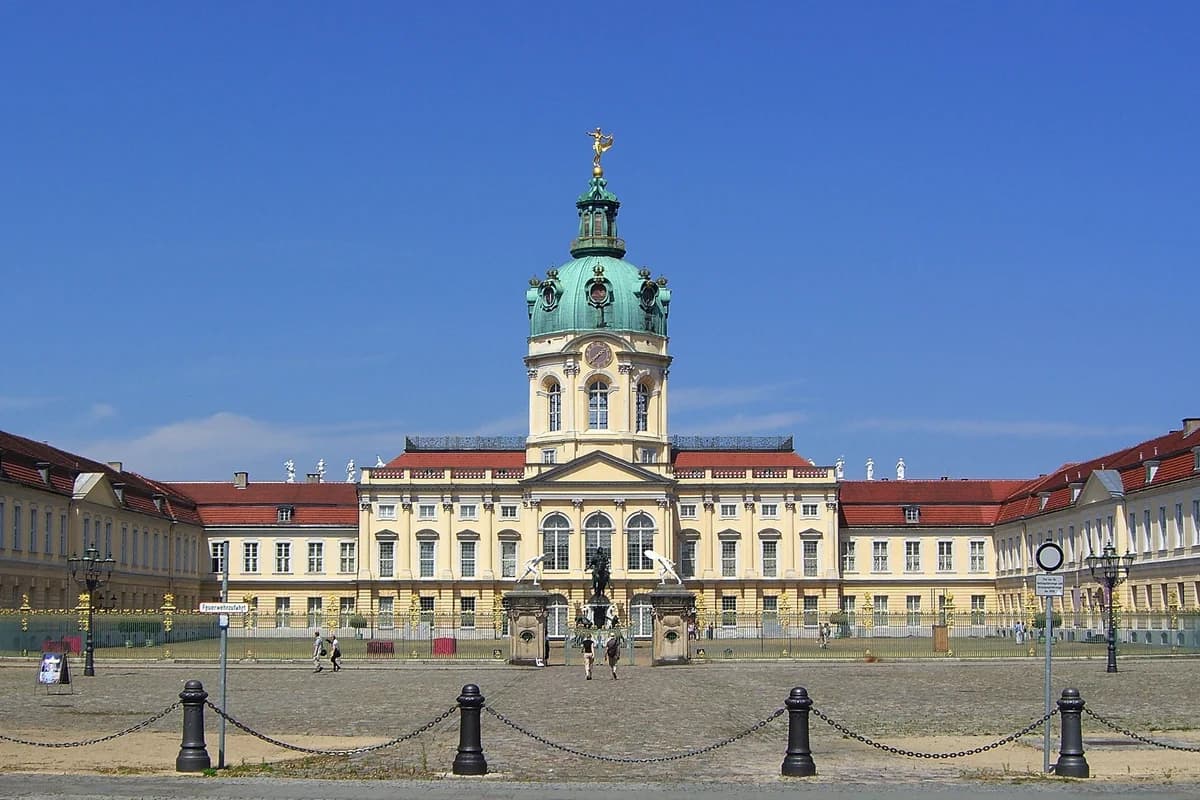 Christoph Müller, CC BY-SA 3.0
Scan it with your phone
Point your camera at the QR code
Charlottenburg Palace: a Queen's Love StoryAudio guide
 Told byLightUp
I’ll tell you the secrets of Charlottenburg Palace. I guide you here with the map, or you can listen from home. What you see is not what you think, and knowing it is worth it. Some narrations are AI voices and others are real people.
Free5 min AI voiceHistory
Audio in:EnglishSpanishGermanFrenchItalianPortugueseChinese
How it works
- Go there
the app walks you there from wherever you are. - Listen there or from home
it plays by itself when you arrive, or press play from wherever you are. In your language if it was recorded in it. - Keep discovering
the Berlin map has more gems like this one, and you can put them together in a tour.
What you'll discover
Charlottenburg Palace began as a gift of love. What happened next, no one expected.
Bombs, a lake, a sunken statue, and a government that tried to erase everything. This story has it all.
Charlottenburg, the largest palace in Berlin. Come, I'll tell you about it.
About Charlottenburg Palace
Stay in front of the main entrance, observe the two wings of the palace opening towards you, the golden dome, and the equestrian statue in the courtyard as I tell you a love story.
Read the whole storyShow less
The palace before you began as a gift. In sixteen ninety-four, Frederick the Third, Elector of Brandenburg, gifted his wife Sophia Charlotte an estate with lands on the outskirts of Berlin, in a village called Lietzenburg. Sophia Charlotte was not just any queen. She was the daughter of the Elector of Hanover,
she grew up surrounded by philosophers and musicians, played the harpsichord, sang Italian opera, and had as a personal friend the philosopher Gottfried Wilhelm Leibniz, one of the most important thinkers in history. Leibniz dedicated his work Theodicy to her, based on the conversations they had while walking through these gardens. They talked about the existence of the soul, perpetual motion machines, and the meaning of life. Sophia Charlotte wanted a place where culture and thought could have a home, and Frederick built it for her.
The architect Johann Arnold Nering designed the original palace in Baroque style. But Nering died during construction, and the project passed to Martin Grünberg and then to the great Andreas Schlüter, one of the most important sculptors and architects of the German Baroque. The inauguration was celebrated on July eleventh, sixteen ninety-nine, the day Frederick turned forty-two years old. But this was just the beginning. Two years later, in seventeen hundred and one, Frederick achieved something that changed the history of Prussia forever:
he crowned himself as the first King of Prussia in a ceremony in Königsberg. He placed the crown on his own head, without any bishop doing it for him, to show that his power did not depend on the Church. From Elector, he became Frederick the First, King in Prussia. And his small summer palace was no longer enough for a king.
Frederick sent the architect Eosander von Göthe to study Versailles. When he returned, he began expanding the palace with two lateral wings that surround the grand courtyard of honor you see before you, and the central dome crowned by the golden statue of Fortuna.
The palace grew to become the largest in Berlin. But in seventeen hundred and five, tragedy struck. Sophia Charlotte, the woman for whom all this was built, died of pneumonia at thirty-six while visiting her mother in Hanover. Frederick, devastated, renamed the palace and the entire village as Charlottenburg in her honor. The name you see today, Charlottenburg, is the name of a woman who died too young.
On November twenty-second, nineteen forty-three, Allied bombs fell on Charlottenburg. The first floor of the central section with the dome was destroyed, along with much of the new wing, the theater, and the Great Orangery. The palace was left in ruins.
The palace had been in ruins for years, an open wound in the heart of Berlin. And then came another blow, this time deliberate: in East Berlin, the communist government demolished the Hohenzollern Royal Palace in nineteen fifty. They simply erased it. Charlottenburg, which had ended up within the western sector of the divided city, faced an uncertain fate.
When West Berliners saw what the communist regime had done on the other side, they made a clear decision: this was not going to happen here. Restoration began immediately and lasted more than sixty years. The equestrian statue you see in the courtyard was created by Andreas Schlüter in sixteen ninety-eight. During the war, it was sunk to the bottom of Lake Tegel to protect it. In nineteen fifty-two, it was rescued and brought here, in front of the main entrance, where it stands today.
From where you are, you can see the complete facade of the original palace with its two wings open like arms welcoming you, the courtyard of honor, the Baroque dome with the golden Fortuna spinning with the wind at the top, and the equestrian statue of the Great Elector Frederick William on horseback in the center of the courtyard. All of this began as a summer house for a woman who preferred talking about philosophy to attending court balls. A woman who inspired Leibniz, who founded the Prussian Academy of Sciences, and who died before seeing completed what her husband built in her name. Charlottenburg is not just a palace. It is a love letter written in stone.
Visiting Charlottenburg Palace
- How to get there
- The closest bus stop is Klausenerplatz, 157 meters away, served by lines M45 and 309.
- Entry and price
- Entry is not free. The adult price is 14.
- Opening hours
- April to October: Tuesday to Sunday 10:00-17:30; November to March: Tuesday to Sunday 10:00-16:30.
Frequently asked questions
What is the history behind Charlottenburg Palace?
Charlottenburg Palace was originally a gift from Frederick III to his wife, Sophie Charlotte, in 1694. It began as a summer residence and was later expanded after Frederick became the first King of Prussia.
What notable architectural features should I look for?
The palace features a Baroque design with two wings, a central dome topped by a golden statue of Fortuna, and an equestrian statue of the Great Elector Frederick William in the courtyard.
What happened to the palace during World War II?
In 1943, Allied bombs destroyed parts of the palace, including the central section with the dome and the new wing. Restoration began after the war and lasted over sixty years.
Who was Sophie Charlotte?
Sophie Charlotte was the wife of Frederick III, known for her intellectual pursuits and friendships with philosophers like Gottfried Wilhelm Leibniz. The palace and the surrounding area were named Charlottenburg in her honor after her death.
More audio guides in Berlin

Reviews
No reviews yet. Be the first.