New Synagogue
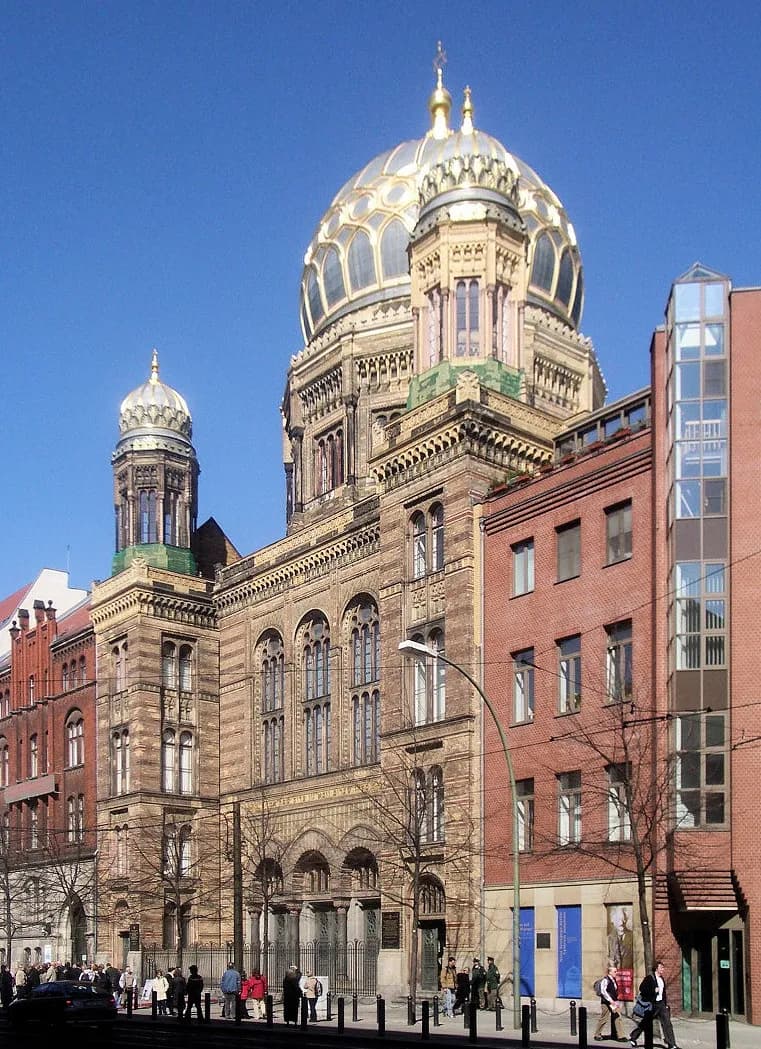 By Andreas Praefcke - Own work, CC BY 3.0
Scan it with your phone
Point your camera at the QR code
New Synagogue Berlin: the Golden DomeAudio guide
 Told byLightUp
I’ll tell you the secrets of New Synagogue. I guide you here with the map, or you can listen from home. What you see is not what you think, and knowing it is worth it. Some narrations are AI voices and others are real people.
€0.995 min AI voiceHistory
Audio in:EnglishSpanishGermanFrenchItalianPortugueseChinese
How it works
- Go there
the app walks you there from wherever you are. - Listen there or from home
it plays by itself when you arrive, or press play from wherever you are. In your language if it was recorded in it. - Keep discovering
the Berlin map has more gems like this one, and you can put them together in a tour.
What you'll discover
The night the Nazis burned synagogues all over Germany, a policeman showed up here with his gun. What he did, no one expected.
This golden dome disappeared for decades. When it returned, Berlin was already a different city. But the synagogue never regained what it had inside.
The New Synagogue has a story of destruction and courage. Join me at its facade and I'll tell you the whole story.
About New Synagogue
Take a moment before continuing. Find a place to sit or lean, because the story of this building deserves to be told slowly. The golden dome over Oranienburger Straße is one of Berlin's most recognizable profiles. From afar it seems intact, almost miraculous. Up close, when you understand the building's history, its survival turns out to be exactly that.
Read the whole storyShow less
The New Synagogue was designed by architect Eduard Knoblauch, who fell seriously ill during construction and had to hand over the project to Friedrich August Stüler, the same architect who later designed the Neues Museum. Construction began in 1859. On September 5, 1866, on the eve of the Jewish New Year, the building was inaugurated. It was the largest synagogue in Germany, with a capacity for three thousand worshippers.
The style is Mudejar Renaissance, directly inspired by the Alhambra in Granada. The facade on Oranienburger Straße is covered with polychrome bricks, horseshoe arches, ornate terracotta, and colored stripes. The central dome, about fifty meters high with golden ribs, was visible from all over the city. It was also a technically pioneering building: iron and steel were visibly used in the structure of the dome, in the outer columns, and in the floor of the main hall, combining 19th-century industrial materials with an exotic historical style.
The inauguration ceremony was an act of civil affirmation. Among the attendees was Otto von Bismarck, at that time Minister President of Prussia, a few days before the Prussian victory parade in front of the Brandenburg Gate. The Jewish community of Berlin attended with their religious authorities the city's most prominent event, and one of the most powerful men in Europe was in the front rows.
On the night of November 9 to 10, 1938, the Nazi government organized a coordinated nationwide attack. In a single night, groups of SA and mobilized civilians simultaneously attacked synagogues, Jewish businesses, and homes throughout Germany and Austria. They burned more than 1,400 synagogues, destroyed thousands of businesses, killed dozens of people, and deported more than 30,000 Jewish men to concentration camps. The streets were covered with broken glass from the destroyed showcases, hence the name: Kristallnacht, the Night of Broken Glass. It was the clearest announcement until that moment of what the regime had planned.
In Berlin that night, a Nazi mob entered the New Synagogue, destroyed the Torah scrolls, piled up combustible furniture, and set it on fire. But the building did not burn completely. A police officer arrived at the scene, declared the building a protected historical monument, drew his gun, and stood guard until firefighters could enter and extinguish the fire. For decades the commemorative plaque on the building, installed in 1995, attributed the gesture to Lieutenant Wilhelm Krützfeld. Subsequent historical research established that the officer who physically confronted the mob was his subordinate, Otto Bellgardt. Krützfeld covered for him afterward. The plaque bears the chief's name. The one who drew the gun was the subordinate.
After Kristallnacht, the building remained standing but was confiscated by the Nazi regime and used as a warehouse by the Wehrmacht. On the night of November 22 to 23, 1943, more than 700 RAF bombers unloaded on Berlin in the largest attack of the Battle of Berlin up to that point. The synagogue was severely damaged and in ruins.
After the war, the building was in the Soviet sector of Berlin, later in the GDR. In 1958, the authorities of East Berlin pressured the small remaining Jewish community in the city to approve the demolition of the rear sections of the building, including the main prayer hall, arguing that there was a risk of collapse. The space where three thousand people had prayed disappeared. Only the front section survived: the facade, the entrance, the dome, and some rooms immediately behind.
The restoration of the front began in 1988, before the fall of the Wall, and concluded after reunification. On May 7, 1995, the building reopened as the Centrum Judaicum, headquarters of the foundation dedicated to preserving the memory and history of Berlin's Jews. It is not a regularly functioning synagogue. It is a memorial and a museum. The golden dome is restored and visible. The huge empty space where the main hall was is now an open courtyard. The absence is deliberately part of the site: what is missing is part of what is commemorated.
Visiting New Synagogue
- How to get there
- The closest stop is Oranienburger Straße (metro/train), 92 meters away. Alternatively, you can use S Oranienburger Straße (tram), 131 meters away, or Monbijouplatz (tram), 222 meters away.
- Entry and price
- Entry is not free. The adult price is 7.
- Opening hours
- Apr-Sep: Mon-Fri 10:00-18:00; Sun 10:00-19:00; Oct-Mar: Sun-Thu 10:00-18:00; Fri 10:00-15:00.
Frequently asked questions
What is the architectural style of the New Synagogue?
The New Synagogue is designed in the Mudéjar Renaissance style, inspired by the Alhambra of Granada. It features polychrome bricks, horseshoe arches, and a central dome with golden ribs.
What significant event happened here during Kristallnacht?
During Kristallnacht, a Nazi mob entered the New Synagogue, destroyed Torah scrolls, and set fire to the furniture. The building was saved from complete destruction by an officer who declared it a protected monument and allowed firefighters to extinguish the fire.
What remains of the original building today?
Today, only the front section of the New Synagogue survives, including the façade, entrance, dome, and some rooms behind it. The main prayer hall, which could hold 3,000 people, was demolished in 1958.
What can I see inside the New Synagogue now?
The New Synagogue now serves as a memorial and museum, not a functioning synagogue. Visitors can see the restored golden dome and the open courtyard where the main hall once stood, symbolizing the absence and memory of what was lost.
What was the New Synagogue used for during World War II?
After Kristallnacht, the building was confiscated by the Nazi regime and used as a warehouse by the Wehrmacht. It was severely damaged during a bombing raid in November 1943.
More audio guides in Berlin

Reviews
No reviews yet. Be the first.