Checkpoint Charlie
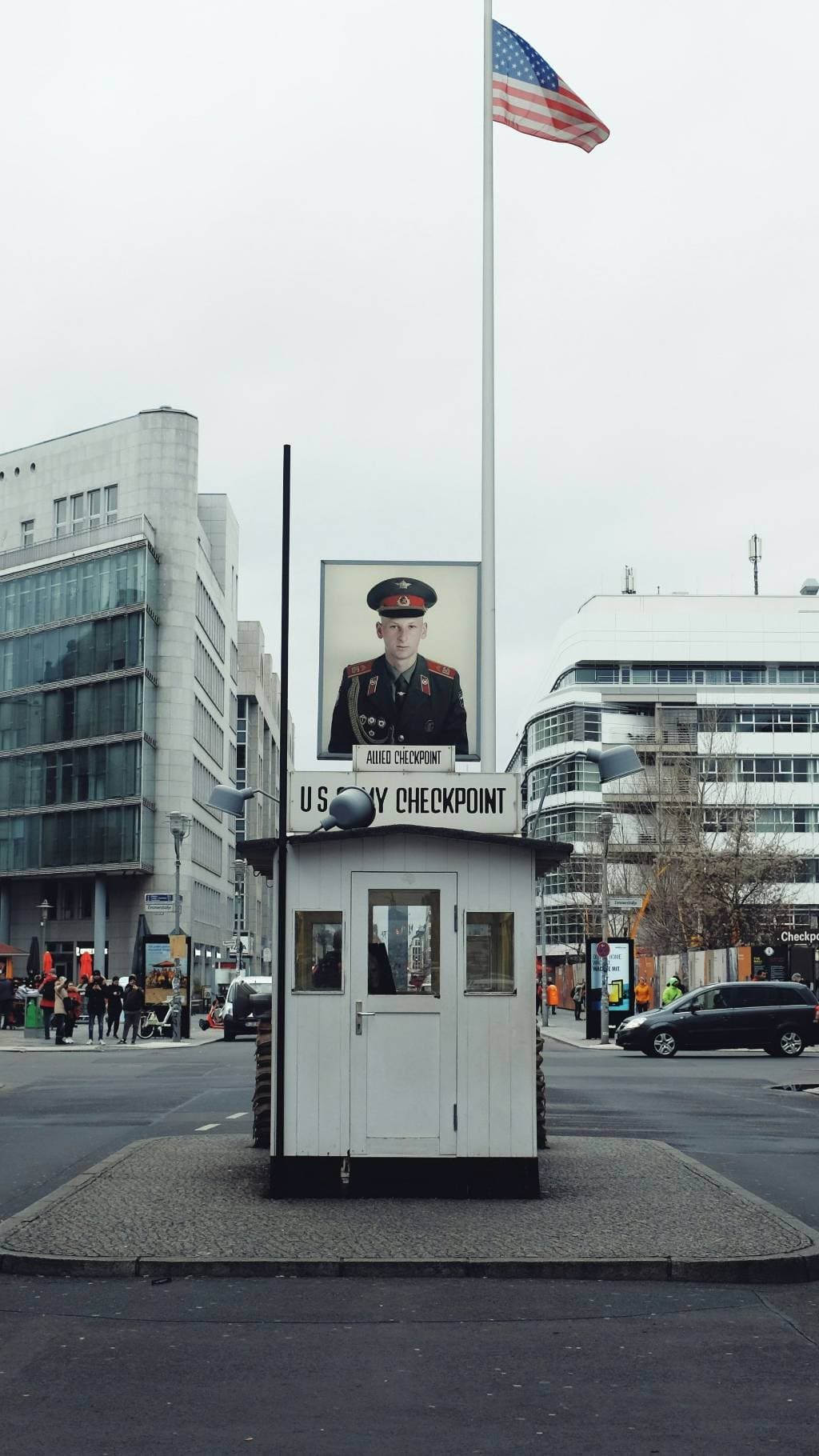 By Roger Wollstadt - Flickr: Berlin - Checkpoint Charlie, CC BY-SA 2.0
Scan it with your phone
Point your camera at the QR code
Checkpoint Charlie: Cold War CrossingAudio guide
 Told byLightUp
I’ll tell you the secrets of Checkpoint Charlie. I guide you here with the map, or you can listen from home. What you see is not what you think, and knowing it is worth it. Some narrations are AI voices and others are real people.
€0.998 min AI voiceHistory
Audio in:EnglishSpanishGermanFrenchItalianPortugueseChinese
How it works
- Go there
the app walks you there from wherever you are. - Listen there or from home
it plays by itself when you arrive, or press play from wherever you are. In your language if it was recorded in it. - Keep discovering
the Berlin map has more gems like this one, and you can put them together in a tour.
What you'll discover
On this corner of Friedrichstraße and Zimmerstraße, a wooden hut separated two worlds: the American sector and the Soviet one.
By 1961 East Germany was emptying out. Since 1949, almost three million people had fled to the West, many of them young and educated.
On 15 June 1961, Walter Ulbricht told the press: "Nobody has any intention of building a wall."
Two months later, in the early hours of 13 August, the closure began: barbed wire first, concrete blocks a few days later.
The Allies opened their crossing here for foreigners, soldiers and diplomats. They called it Charlie, after the C in the NATO radio alphabet.
There were two others, Alpha at Helmstedt and Bravo at Dreilinden, but Charlie was the only one inside the city.
On 22 October 1961, East German guards asked the American diplomat Allan Lightner for his papers as he drove to the opera in the East. He refused: only the Soviets had that right.
On 27 October, American and Soviet tanks stood face to face right here.
For some sixteen hours the world held its breath, until the Soviets pulled back first.
On 17 August 1962, Peter Fechter, aged 18, was shot trying to climb the wall a few metres from here. He lay dying for almost an hour and nobody helped him.
In 1963 the Austrian Heinz Meixner took the windscreen off his Austin-Healey, let some air out of the tyres and drove under the barrier. Hidden inside were his fiancée and her mother, surrounded by bricks.
The Wall fell on 9 November 1989, and the hut was lifted away by crane on 22 June 1990. The original is now in the Allied Museum.
The one you see is a replica from 2000, with sandbags and the sign: "You are leaving the American sector".
About Checkpoint Charlie
You have arrived at Checkpoint Charlie. Look at that white guardhouse you see there in the middle of the street. That guardhouse was the checkpoint where American soldiers decided who could pass and who couldn't between West Berlin and East Berlin. Imagine, on this very street where you now see tourists taking pictures, just a few decades ago there were armed soldiers, metal barriers, sandbags, and barbed wire.
Read the whole storyShow less
Now, as you walk around the guardhouse and see all those lost tourists wandering back and forth, let me tell you the story of this border crossing.
Let's start with the basics. Why is it called Checkpoint Charlie? It's not because some guy was named Charlie. When the Allies, meaning the United States, the United Kingdom, and France, occupied Berlin after World War II, they created three checkpoints to enter and exit the Soviet zone. They named them with the NATO military alphabet. The first, on the Helmstedt highway, was called Alpha. The second, in Dreilinden, was called Bravo. And this one, the third, on Friedrichstraße where you are standing now, was called Charlie. It's that simple. Alpha, Bravo, Charlie. The third checkpoint.
But Charlie wasn't just any checkpoint. It was the only authorized crossing for foreigners, diplomats, and allied military personnel. If you were an ordinary German, you couldn't cross here. This was exclusively for the power play between the great powers. And precisely because of that, things happened here that almost changed the history of the world.
Now let me tell you why in this place where you are standing, a Third World War almost started.
Imagine this street where you are now. October 1961. The Berlin Wall had been built just two months earlier. One night, an American diplomat named Allan Lightner wanted to cross into East Berlin to go to the opera. Yes, to the opera. The East German guards demanded that he show his documents. But there was an agreement among the four powers that said the Allies could move freely throughout Berlin without showing documents to the Germans. It was an agreement between the powers, not with Germany. Lightner refused to show anything. The guards didn't let him pass.
When Washington found out, the response was brutal. General Lucius Clay sent ten American M48 tanks with live ammunition to this street. They parked them right where you are walking now. The Soviets responded in kind. Ten Soviet T-55 tanks appeared on the other side. For sixteen hours, twenty tanks with loaded ammunition and nervous soldiers aimed at each other from a hundred meters away. A hundred meters. That's less than a block. One nervous soldier, one trembling finger on the trigger, and World War III would have started right here, on this street where you are standing.
Do you know how it was resolved? It wasn't at a negotiation table. It was secret conversations between Robert Kennedy, the president's brother, and a Soviet intelligence agent named Georgi Bolshakov. They agreed on something very simple: one American tank backs up, then one Soviet tank backs up, then another American, then another Soviet. One by one, alternating, like a dance. And so, as silently as they had arrived, the tanks disappeared from this street. The world breathed again.
But Checkpoint Charlie wasn't just a place of military tension. It was also spy territory. And something happened here that might sound familiar because Steven Spielberg made a movie about it, Bridge of Spies.
In the midst of the Cold War, the Soviets had captured an American CIA pilot named Gary Powers. They shot him down while he was flying a U-2 spy plane over Soviet territory. And the Americans had a Soviet spy named Rudolf Abel in custody, one of the best KGB agents who had operated for years in New York undetected.
The two powers negotiated an exchange. On February 10, 1962, at the Glienicke Bridge, on the outskirts of Berlin, Abel and Powers walked in opposite directions, crossing in the middle of the bridge. Each returned to their side. But what few people know is that on that same day, here, at this Checkpoint Charlie where you are standing, the Americans picked up Frederic Pryor, an American university student whom the East Germans had arrested, accusing him of espionage. Pryor was simply an economics student researching for his thesis, but the Stasi used him as a bargaining chip. Lawyer James Donovan, a civilian with no espionage experience, negotiated the complete package: Abel for Powers on the bridge, and Pryor released here at Charlie. Three lives, two exchange points, one single negotiation. And this checkpoint was a central part of that story.
Now, can you imagine that all the restrictions that had been imposed for twenty-eight years on Berliners were lifted suddenly by a simple mistake?
On November 9, 1989, the East German government had prepared a new regulation to slightly relax travel restrictions. Just a little. The idea was to allow some travel with special permits and many bureaucratic requirements. They gave the statement to Günter Schabowski, the government spokesman, to read at a press conference. But Schabowski hadn't been at the meeting where the document was discussed. No one explained the details to him.
So when an Italian journalist asked him when the new rules would take effect, Schabowski looked through his papers, shrugged, and said, "As far as I know, immediately, without delay." Those words changed history. The news was broadcast live on television. Thousands of East Berliners watching the conference couldn't believe it. They took to the streets and rushed to the Wall's checkpoints.
The border guards had no orders. They called their superiors. No one answered. No one knew what to do. The crowd grew and grew. There were thousands of people pushing, shouting, crying. Finally, a guard named Harald Jäger, at the Bornholmer Straße crossing, decided to open the barriers on his own. He later said he feared a massacre if he didn't. And once one point opened, all the others fell like dominoes.
Here, at Checkpoint Charlie, the scene was equally chaotic and exciting. People who hadn't seen their families in decades ran across, hugging, crying. People from the West crossed into the East with bottles of champagne. Strangers hugged in the street. Twenty-eight years of separation, of divided families, of people dying trying to cross a wall, all ended because a bureaucrat didn't read his papers well.
You are standing in one of the most important places of the twentieth century. Every square meter of this street has a story. Here a world war almost started, here spies were exchanged like in the movies, and here, one November night, freedom won because of a bureaucratic error.
Visiting Checkpoint Charlie
- How to get there
- The closest stop is U Kochstraße/Checkpoint Charlie bus stop, 69 meters away. The Kochstraße/Checkpoint Charlie metro/train stop is 101 meters away.
- Entry and price
- It's an open-air, free public area — no tickets needed, visit anytime!
Frequently asked questions
What can I see at Checkpoint Charlie?
You can see the iconic white guardhouse that was the checkpoint where American soldiers controlled passage between East and West Berlin.
What historical events took place here?
In October 1961, a standoff between American and Soviet tanks occurred here, nearly sparking a global conflict. It was also a site for spy exchanges during the Cold War.
What happened on November 9, 1989, at Checkpoint Charlie?
On this day, the Berlin Wall restrictions were lifted due to a bureaucratic error, leading to a spontaneous and emotional crossing of people between East and West Berlin.
Is there anything nearby worth visiting?
Nearby, you can visit the Mauermuseum and BlackBox Kalter Krieg, both offering insights into the Cold War era.
More audio guides in Berlin

Reviews
No reviews yet. Be the first.