
Brutalist Apartment Block
聆听 Brutalist Apartment Block 的故事
下载 LightUp 应用或用手机扫描二维码。你将用自己的语言聆听这个地方的故事——支持 7 种语言,AI 与真人配音。免费开始,按自己的节奏游览 Berlin。
用手机扫描
将相机对准二维码
故事
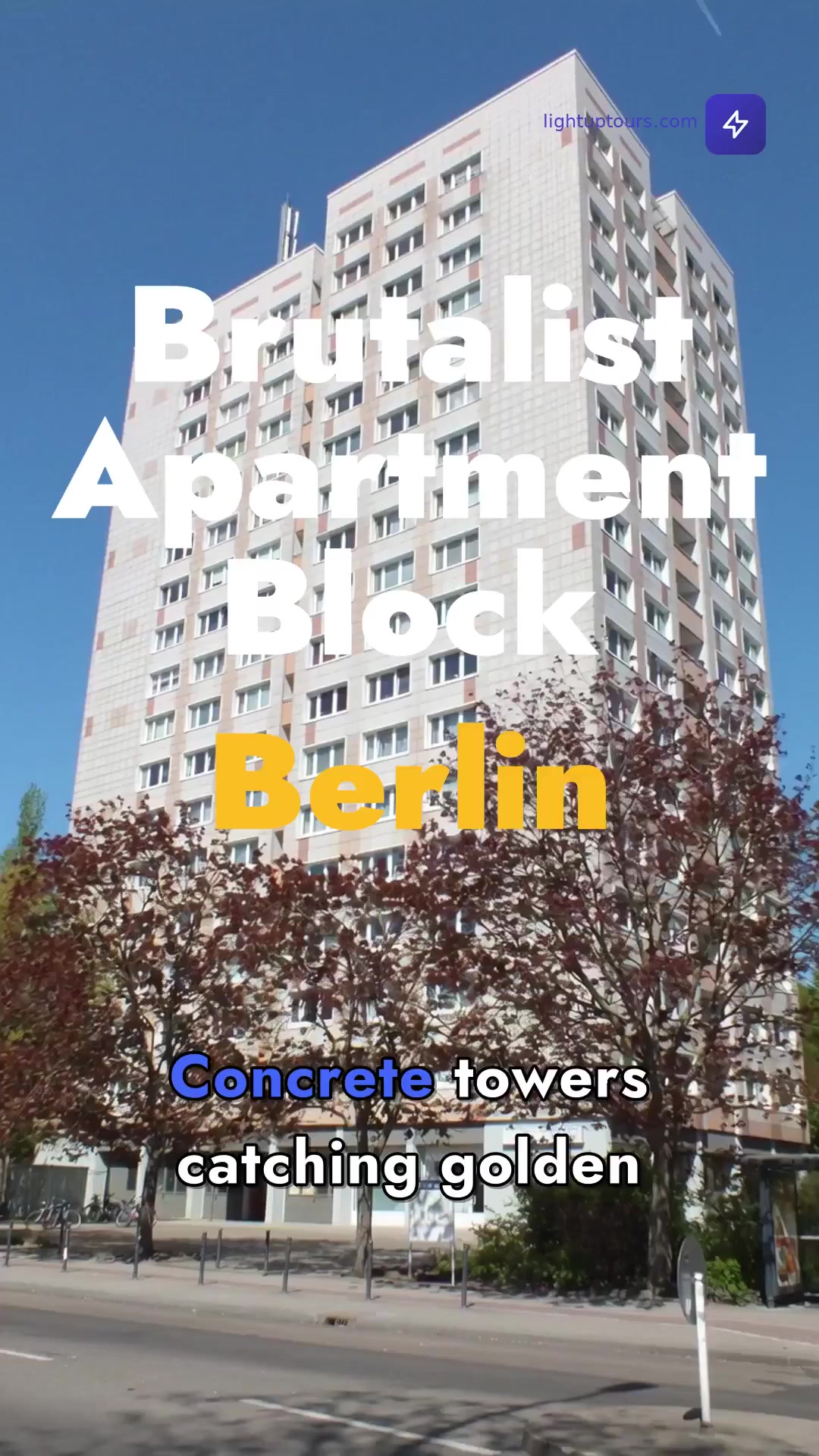
Concrete towers catching golden light. You're standing in the Sewanviertel, East Berlin's first major housing experiment after the Wall went up.
In nineteen sixty-one, the city needed thousands of apartments fast. The government answered with prefabricated slabs, cranes, and speed.
They built the Hans-Loch-Viertel — this neighborhood — between nineteen sixty-one and nineteen sixty-six. Five thousand apartments for fifteen thousand people on eighty hectares.
Look at the grid. Every rectangle is a room. Each slab was poured in a factory, trucked here, and lifted into place.
It was named after Hans Loch, East Germany's finance minister, who had died the year before construction began.
What made people want them? Hot water. A private bathroom. Central heating. Luxuries in East Berlin's crumbling old tenements.
A sixty-one square meter flat — two bedrooms, living room, kitchen, bath — cost one hundred nine marks a month. The average salary was over a thousand.
After nineteen ninety-two, the street names changed. Hans-Loch-Straße became Sewanstraße, named after Lake Sevan in Armenia. The district followed.
Today these blocks have been renovated. New windows, insulation, color. They're still home to thousands — not relics, but living neighborhoods.
These towers held families, birthday parties, arguments, first loves. They're part of Berlin's memory now — proof that everyday life continued, even in a divided city.
Listen to the full audio guide and I'll show you how these slabs became a future people believed in.
Berlin 的更多语音导览



评论
还没有评论。