Memorial Große Hamburger Straße
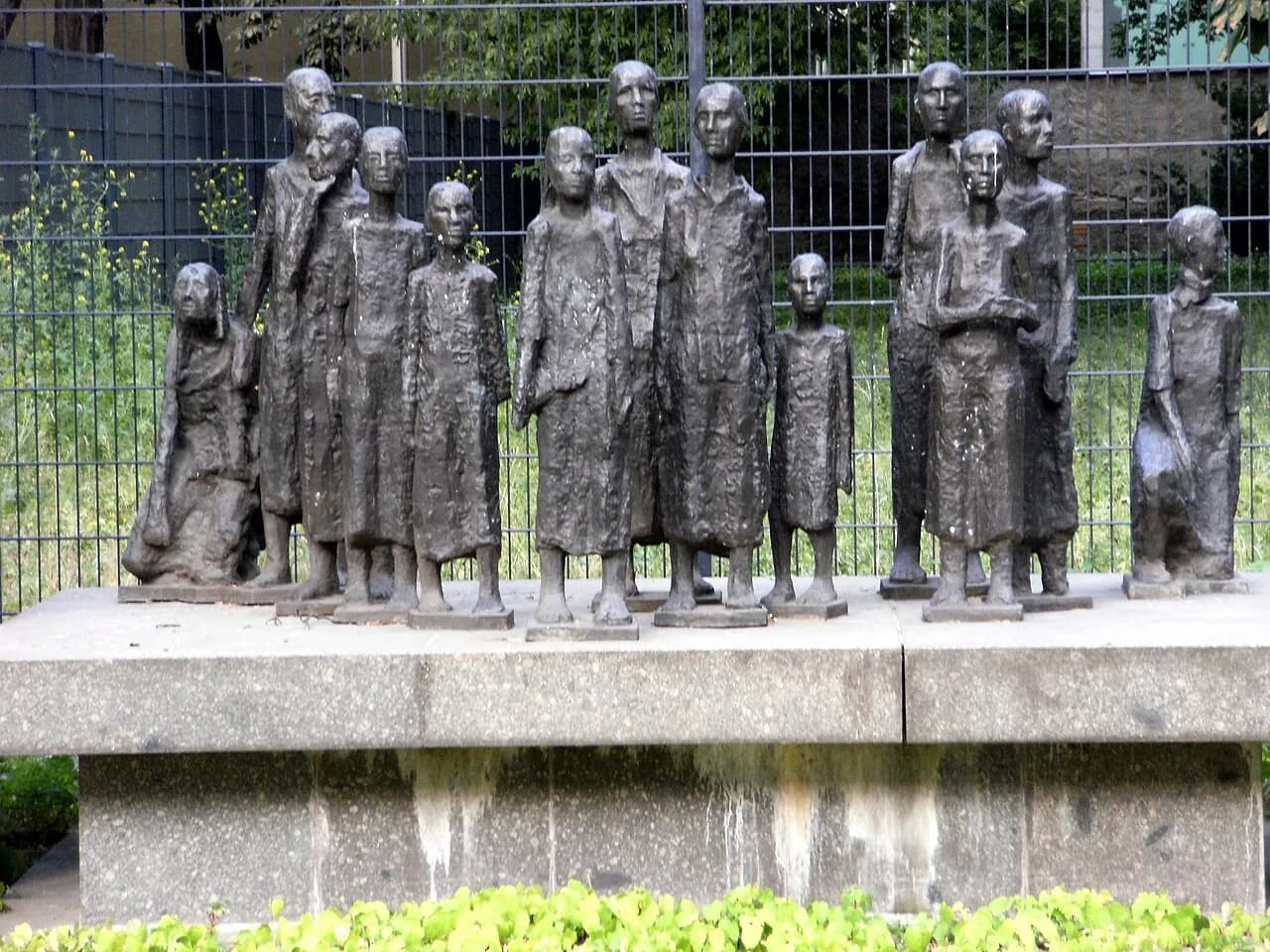 By Mark Ahsmann - Own work, CC BY-SA 3.0
Scan it with your phone
Point your camera at the QR code
Jewish Berlin: Große Hamburger StraßeAudio guide
 Told byLightUp
I’ll tell you the secrets of Memorial Große Hamburger Straße. I guide you here with the map, or you can listen from home. What you see is not what you think, and knowing it is worth it. Some narrations are AI voices and others are real people.
€0.995 min AI voiceHistory
Audio in:EnglishSpanishGermanFrenchItalianPortugueseChinese
How it works
- Go there
the app walks you there from wherever you are. - Listen there or from home
it plays by itself when you arrive, or press play from wherever you are. In your language if it was recorded in it. - Keep discovering
the Berlin map has more gems like this one, and you can put them together in a tour.
What you'll discover
In this quiet street, the Nazis gathered thousands of people before deporting them. Today there is an empty space that silently screams.
A desecrated cemetery, a school turned into a detention center, and an act of resistance that saved lives at this very address.
Große Hamburger Straße has visible scars if you know where to look. I will take you there and tell you the story.
About Memorial Große Hamburger Straße
>> Approach the memorial, observe the bronze figures and the solitary tombstone among the trees. This is one of the most important places in the Jewish history of Berlin. Stay here and listen.
Read the whole storyShow less
In 1743, a fourteen-year-old Jewish boy walked to Berlin from the city of Dessau. His name was Moses Mendelssohn. He was the son of a poor scribe who hand-copied Torah scrolls. As a child, he developed a hump on his back, a curvature of the spine that would accompany him for life.
He came to Berlin following his teacher, Rabbi David Fränkel, who had been called to the capital. To enter the city, Moses had to pass through the Rosenthaler Tor, the only gate in the wall where Jews were allowed to enter. The same gate through which cattle passed. The gatekeeper's record of that day noted: "through the Rosenthal gate entered six oxen, seven pigs, and one Jew." Thus came to Berlin the man who would change the history of European thought.
Moses had no money, no connections, nothing but an extraordinary intelligence. He taught himself Latin, Greek, French, English, and mathematics. With the little he earned, he bought a Latin copy of John Locke's Essay Concerning Human Understanding and deciphered it word by word with the help of a dictionary. He met the writer Gotthold Ephraim Lessing, who became his best friend and who was inspired by him to write Nathan the Wise, one of the most important works of German theater.
In 1763, Mendelssohn won the Berlin Academy prize for an essay on metaphysics. Second place went to one Immanuel Kant. A hunchbacked boy who had entered Berlin through the cattle gate beat Kant. They called him "the German Socrates," "the Jewish Luther." He proved that a Jew could be one of the greatest thinkers in Europe.
Moses Mendelssohn died on January 4, 1786, at the age of fifty-six. They say he caught a cold while carrying a manuscript to his publisher on New Year's Eve and never recovered. He was buried here, in the Jewish cemetery on Große Hamburger Straße, the oldest Jewish cemetery in Berlin, inaugurated in 1672. Alongside him were buried some of the most important Jews of the city. His grandson, Felix Mendelssohn, would become one of the greatest composers in history. The Mendelssohn family, from 1762 to 1933, produced philosophers, bankers, musicians, scientists, and artists who transformed German culture. It all started with a hunchbacked boy from Dessau.
In 1943, one hundred and fifty-seven years after Mendelssohn's death, the Gestapo came to Große Hamburger Straße. They destroyed the cemetery. They ripped the tombstones from the graves and used them to reinforce the walls of trenches and air-raid shelters. The bones of Mendelssohn, of Veitel Heine Ephraim, of Daniel Itzig, of entire generations of Berlin Jews, were unearthed and scattered. With the stones that marked their names, they built walls to protect themselves from bombs. The Nazis used the Jewish dead as building material.
But the worst was not the cemetery. Next door was a Jewish old people's home. In 1942, the Gestapo confiscated it and turned it into a Sammellager, a collection camp. Here they brought the Jews of Berlin before deporting them to the extermination camps. From this building, on this street, fifty-five thousand Berlin Jews were sent to Auschwitz and Theresienstadt. From babies to the elderly. Most were murdered. Fifty-five thousand people passed through this street in one direction only. The place where Mendelssohn had shown that Jews and Christians could live together as equals became the anteroom of extermination.
Today what you see here is an empty space among the trees. The cemetery no longer exists as such. The Nazis destroyed it. After the war, a symbolic tombstone was placed in honor of Moses Mendelssohn because the original was destroyed. There is a sarcophagus filled with fragments of broken tombstones, the little that could be recovered. And there are bronze figures representing the Jews deported from this place. This piece of land tells two hundred years of Jewish history in Berlin in just a few meters: the oldest cemetery, the most brilliant philosopher, the most complete destruction, and the silence they left behind. All here, on Große Hamburger Straße.
Visiting Memorial Große Hamburger Straße
- How to get there
- The closest tram stop is Monbijouplatz, 125 meters away. S Hackescher Markt tram stop is 201 meters away, and U Weinmeisterstraße/Gipsstraße tram stop is 259 meters away.
- Entry and price
- Entry is free.
- Opening hours
- The site is always open.
Frequently asked questions
What can I see at the Memorial Große Hamburger Straße?
You can see figures of bronze and a symbolic gravestone for Moses Mendelssohn among the trees. There is also a sarcophagus filled with fragments of broken gravestones.
Why is Moses Mendelssohn significant to this site?
Moses Mendelssohn was a pivotal figure in Jewish history in Berlin. He was buried here, and his symbolic gravestone remains after the original was destroyed during the Nazi era.
What happened to the cemetery during the Nazi era?
In 1943, the Gestapo destroyed the cemetery, using the gravestones to reinforce walls of trenches and shelters. The bones of those buried were disinterred and scattered.
What historical events are associated with this location?
This site was a Sammellager, a collection camp, where 55,000 Berlin Jews were gathered before being deported to extermination camps like Auschwitz and Theresienstadt during the Nazi era.
What is nearby the Memorial Große Hamburger Straße?
Nearby, you can find the Peace Wall, Arnold David Koller, and Magicum, which is open daily with varying hours.
More audio guides in Berlin

Reviews
No reviews yet. Be the first.